Tower of Babel

Tower of Babel

We climb John H. Steele’s Tower of Babel, a Mage novel full of creators, characters, conspiracies, and reality getting mighty leaky around the edges. It’s metafiction, Technocracy trouble, dream-tower theology, and one poor writer learning that when your fiction talks back, maybe don’t answer after drinking.

Show Notes

  • Tower of Babel – Book man invents fascist action guy. Fascist action guy becomes real. Magic happens. Bureaucrats get spooky. Reality files a complaint.
  • John H. Steele – wrote lots of White Wolf fiction, helped shape the Clan Novel Saga, and used the pen name Gherbod Fleming.

Executive Producers

Oracles

Bad Company • Buck Gregory • Christopher Phillips • Derek Semsick • DrawnCap • DrunkDez • Jason Vines • Rebecca Pool • Sean Gallagher • Spartacus • The Krewe of Erebuss

Archmasters

Berto • Brad-O-the Blue • Dan Svensson • Glacial Indifference • Jeffois • Leroy Bryce • Morgan Aran • Wolf Larryson

Acolytes

Aleks • Alexia • Ambiversion • Anders S • Ben Bandelow • Blaise Hebert • Bruno Teixeira • Bryce Perry • Bubba, The Pale One • Chartan • Cig • Curtis Hendricks • Darren Hennessey • Daniel Cuppen • Daniel Scribner • Dan Svensson • David Röhe • Ean Robertson • EBG • Eric Schwenke • Gray -Trilug- H • Guy Stewart • Ia Bull • James B • Jason Kennedy • Jenna F • Jeremy Z • Jervis Johnson • Kathleen Hailperin • Kevin Fitzpatrick • Khris Kinner • Leslie Weatherstone • Lolz & stuff • Loren Jensen • Manel Canós • Matthew Proehl • Maurice Hopkins • Melissa Krause • Michael Parker • Nebero • Nikita Kleymenov • Patrick McNamara • RobH • Ryan • Ryan Kendy • Ryan Stray • Samuel Tobin • Sev Nessus • Shell Konch • Starfish • Stefan Carton • Tyler Bryan • Will Vincent • Ygard

Become a supporter of Mage: The Podcast.

Contact us at magethepodcast@gmail.com with feedback and comments, and please help extend the reach of the show by sharing it with friends.

Follow Us

Listen on Apple Podcasts, Spotify, YouTube, or your favorite podcast app.

Join our Discord server.

The Sound of Awakening: Building Atmosphere in Your Mage Chronicle

”The first spell your players experience isn't cast by a character. It's cast by the room.”

Rules matter. Characters matter. Your city matters.

But there’s another tool that's surprisingly powerful, and surprisingly underused.

Music.

Not background noise. Not a random Spotify playlist.

Atmosphere.

The right soundtrack tells your players what kind of reality they’ve stepped into before anyone says a word.

Every Chronicle Has a Sound

Mage: The Ascension isn’t just a game about magic. It’s a game about hidden truths. Urban myths. Conspiracy. Spiritual awakening. Decaying cities. Impossible technology. Late-night diners. Rain-soaked streets. Abandoned subway stations. Boardrooms where reality is negotiated one quarterly report at a time.

Your soundtrack should reflect that.

The music you choose teaches your players how to feel about the world.

Don’t Build a Playlist. Build Emotional States.

Instead of creating one giant playlist, organize your music by mood.

Awakening

Wonder. Curiosity. The impossible becoming possible.

The moment a Sleeper realizes the world isn’t what they were told.

Look for music that feels spacious, mysterious, and slightly transcendent.

Investigation

Libraries. Archives. Old maps. Occult bookstores. Corporate servers.

The quiet excitement of discovering a clue nobody was supposed to find.

Subtle ambient music works better than dramatic scores.

Urban Dread

The city at 2:00 a.m. Empty trains. Neon reflections on wet pavement. Something following you, but never quite visible.

This is where dark ambient, trip-hop, noir jazz, and industrial textures shine.

The Umbra

The Umbra should never sound comfortable.

It should feel ancient. Alien. Sacred. Beautiful. Dangerous.

Think choirs, drones, ritual percussion, and sounds that don’t quite belong to the modern world.

The Technocracy

Order. Precision. Efficiency. Control.

Minimal electronic music, glitch textures, deep drones, and sterile soundscapes help reinforce the Union’s worldview.

The Technocracy doesn’t think it's evil. It thinks it’s necessary. Its music should feel the same way.

The Traditions

Each Tradition deserves its own musical identity.

The Virtual Adepts shouldn’t sound like the Verbena.

The Akashayana shouldn’t sound like the Sons of Ether.

The Cult of Ecstasy almost certainly shouldn’t sound like anyone else.

Let your players recognize a faction before an NPC even speaks.

Our Recommendations

These artists and labels consistently capture the emotional landscape of Mage.

Cryo Chamber

Cryo Chamber may be one of the best labels for Mage atmosphere, especially if your chronicle leans toward the Umbra, Technocracy ruins, cosmic horror, abandoned constructs, occult investigation, or Nephandi dread.

The label specializes in cinematic dark ambient: deep drones, haunted soundscapes, ritual textures, post-human cities, and the feeling that reality has been quietly compromised.

Best for: Umbra scenes, Nephandi horror, Technocracy facilities, abandoned chantries, dream sequences, strange archives, and moments when players realize the world is much older and less stable than they thought.

Start with:

Use Cryo Chamber when you don’t want music to “score” a scene so much as infect it.

Nine Inch Nails

Nine Inch Nails is Industrial tension. Isolation. Technology. Transformation.

Perfect for Technocracy operations, abandoned laboratories, and chronicles where the machinery of Consensus is beginning to crack.

Massive Attack

Massive Attack is urban melancholy. Secrets. Late-night cities.

The feeling that someone is watching.

Ideal for investigative chronicles, street-level mysteries, and cabals who meet in bad apartments above worse nightclubs.

Dead Can Dance

Dead Can Dance is ancient ritual. Sacred mystery. The Umbra. Dreams.

Perfect for Spirit chronicles, ecstatic visions, funerary rites, forgotten temples, and moments of transcendence.

Coil

Coil is occult experimentation made audible.

Uncomfortable. Beautiful. Strange.

If any band accidentally wrote a soundtrack for Mage, it might be Coil.

Use carefully. Coil can turn a normal scene into something unstable very quickly.

Bohren & der Club of Gore

Imagine jazz playing in an empty city where reality has quietly stopped working. That’s Bohren & der Club of Gore.

Slow. Patient. Uneasy.

Excellent for detective stories, supernatural noir, late-night investigations, and conversations with people who know more than they should.

Trent Reznor & Atticus Ross

Modern dread. Minimalism. Psychological pressure.

Trent Reznor & Atticus Ross works beautifully during investigation scenes and quiet conversations where everyone knows something terrible is coming.

Beyond Music

Atmosphere isn’t only sound.

Consider adding:

  • Rain against windows
  • Train stations
  • Cathedral echoes
  • CRT monitor hum
  • Coffee shop ambience
  • Distant church bells
  • Industrial machinery
  • Electrical interference
  • Wind through abandoned buildings
  • Tape hiss
  • Radio static
  • Elevator drones
  • Server-room noise
  • Subway brakes
  • Distant sirens

Small sounds can make your world feel larger than your table.

How to Use Music Without Overpowering the Game

The best soundtrack supports the scene without fighting the players.

Keep it low.

Avoid lyrics during important dialogue unless the song is meant to dominate the moment.

Use different playlists for different emotional states.

And don’t be afraid of silence.

In Mage, silence can be as powerful as music.

A sudden lack of sound can tell players something has changed before they understand what.

A Soundtrack Is Worldbuilding

Players remember feelings longer than they remember mechanics.

Years from now they may not remember exactly how Correspondence worked.

They will remember that one piece of music that played while they stepped into the Umbra for the first time.

Or the track that was quietly playing when they realized their mentor had been lying to them for months.

That’s atmosphere. That’s storytelling. That’s Mage.

We’d Love to Hear Yours

Every Storyteller has discovered an artist, album, or playlist that somehow feels like Mage. Tell us what belongs on the soundtrack to Awakening.

Share your recommendations in our Discord, or tag us on social media. We’ll keep expanding this list as the community discovers new sounds that make the Tellurian come alive.

Because every chronicle has a soundtrack.

The only question is whether you’ve chosen it yet.

Contact us at magethepodcast@gmail.com with feedback and comments, and please help extend the reach of the show by sharing it with friends.

Follow Us

Listen on Apple Podcasts, Spotify, YouTube, or your favorite podcast app.

Join our Discord server.

Crossover: Rokea in Mage

Crossover: Rokea in Mage

Adam swims with the sharks to bring you information and ideas to help you add the Rokea, the shape shifting sharks of the World of Darkness, to your games. What are the Kahu hiding?  What lies at the bottom of ocean trenches? Why don’t sharks floss? Tune in and find out.

📄 Transcript of Crossover: Rokea in Mage

Show Notes

  • Rokea – Immortal weresharks, ancient sea-born shapeshifters who form Slews, use electric “Sending,” heal in saltwater, and ally with Mokolé.

Executive Producers

Oracles

Bad Company • Buck Gregory • Christopher Phillips • Derek Semsick • DrawnCap • DrunkDez • Jason Vines • Rebecca Pool • Sean Gallagher • Spartacus • The Krewe of Erebuss

Archmasters

Berto • Brad-O-the Blue • Dan Svensson • Glacial Indifference • Jeffois • Leroy Bryce • Morgan Aran • Wolf Larryson

Acolytes

Aleks • Alexia • Ambiversion • Anders S • Ben Bandelow • Blaise Hebert • Bruno Teixeira • Bryce Perry • Bubba, The Pale One • Chartan • Cig • Curtis Hendricks • Darren Hennessey • Daniel Cuppen • Daniel Scribner • Dan Svensson • David Röhe • Ean Robertson • EBG • Eric Schwenke • Gray -Trilug- H • Guy Stewart • Ia Bull • James B • Jason Kennedy • Jenna F • Jeremy Z • Jervis Johnson • Kathleen Hailperin • Kevin Fitzpatrick • Khris Kinner • Leslie Weatherstone • Lolz & stuff • Loren Jensen • Manel Canós • Matthew Proehl • Maurice Hopkins • Melissa Krause • Michael Parker • Nebero • Nikita Kleymenov • Patrick McNamara • RobH • Ryan • Ryan Kendy • Ryan Stray • Samuel Tobin • Sev Nessus • Shell Konch • Starfish • Stefan Carton • Tyler Bryan • Will Vincent • Ygard

Become a supporter of Mage: The Podcast.

Contact us at magethepodcast@gmail.com with feedback and comments, and please help extend the reach of the show by sharing it with friends.

Follow Us

Listen on Apple Podcasts, Spotify, YouTube, or your favorite podcast app.

Join our Discord server.

Reality Deviants Book Club: Dark City

Reality Deviants Book Club: Dark City

Adam and Pooka discuss Dark City (1998). Another movie that paints the World of Darkness on the screen for you to see. This one aligns so closely with Mage: The Ascension (First Edition) ; watch out for Paradox. Can this inspire you to portray Sphere effects in your game? Is it a good example of a mage’s Awakening? Can bald, creepy kids boost your game to the next level? Tune in and find out!

📄 Transcript of Reality Deviants Book Club: Dark City

Show Notes

  • Dark City (1998) – An amnesiac fugitive hunts his identity while evading police and reality-warping “Strangers.”
  • The Paradox Wheel – An online resource for Mage fans by DrunkDez.

Executive Producers

Oracles

Bad Company • Buck Gregory • Christopher Phillips • Derek Semsick • DrawnCap • DrunkDez • Jason Vines • Rebecca Pool • Sean Gallagher • Spartacus • The Krewe of Erebuss

Archmasters

Berto • Brad-O-the Blue • Dan Svensson • Glacial Indifference • Jeffois • Leroy Bryce • Morgan Aran • Wolf Larryson

Acolytes

Aleks • Alexia • Ambiversion • Anders S • Ben Bandelow • Blaise Hebert • Bruno Teixeira • Bryce Perry • Bubba, The Pale One • Chartan • Cig • Curtis Hendricks • Darren Hennessey • Daniel Cuppen • Daniel Scribner • Dan Svensson • David Röhe • Ean Robertson • EBG • Eric Schwenke • Gray -Trilug- H • Guy Stewart • Ia Bull • James B • Jason Kennedy • Jenna F • Jeremy Z • Jervis Johnson • Kathleen Hailperin • Kevin Fitzpatrick • Khris Kinner • Leslie Weatherstone • Lolz & stuff • Loren Jensen • Manel Canós • Matthew Proehl • Maurice Hopkins • Melissa Krause • Michael Parker • Nebero • Nikita Kleymenov • Patrick McNamara • RobH • Ryan • Ryan Kendy • Ryan Stray • Samuel Tobin • Sev Nessus • Shell Konch • Starfish • Stefan Carton • Tyler Bryan • Will Vincent • Ygard

Become a supporter of Mage: The Podcast.

Contact us at magethepodcast@gmail.com with feedback and comments, and please help extend the reach of the show by sharing it with friends.

Follow Us

Listen on Apple Podcasts, Spotify, YouTube, or your favorite podcast app.

Join our Discord server.

Chronicle Planning: Building Mage Campaigns That Change the Way Your Players See Reality

”A Mage chronicle isn’t about saving the world. It's about discovering which world you're actually living in.”

One of the biggest mistakes new Storytellers make is trying to write a Mage-chronicle like it’s a fantasy adventure.

A villain. A quest. Three acts. A final battle.

Mage-can certainly tell stories like that, but the game’s greatest strength lies somewhere else.

Mage-asks questions.

What is reality?

Who decides what’s true?

What would you sacrifice to change the world?

What happens when your deepest beliefs collide with someone else’s?

The best chronicles don’t begin with a plot. They begin with a question.

Start With a Theme, Not a Villain

Before you write your first scene, ask yourself:

What is this chronicle really about?

Not what happens. What it means.

Examples:

  • The price of certainty
  • Technology replacing faith
  • Tradition versus progress
  • Identity in the digital age
  • The corruption of good intentions
  • Memory versus history
  • What happens when everyone believes a comforting lie?

Once you know the question, every NPC, faction, and mystery begins orbiting that central idea.

Build a City, Not a Dungeon

Mage-thrives in places that already feel alive.

Your city isn’t just a backdrop.

It's another character.

Ask yourself:

  • Who secretly controls this city?
  • Where do mages gather?
  • Which neighborhoods feel haunted?
  • What happened here fifty years ago?
  • Where does the Gauntlet feel thin?
  • What does the Technocracy own?
  • What stories do Sleepers tell themselves that aren't quite true?

When players care about the city, every victory, and every loss, feels personal.

Create Factions With Competing Truths

One of Mage’s greatest strengths is that nearly everyone believes they’re right.

The Traditions aren’t “good.” The Technocracy isn’t “evil. The Nephandi don’t think they’re monsters.

Build every faction around a worldview rather than an alignment.

Ask:

  • What do they believe?
  • Why are they convinced they're saving the world?
  • What would make them compromise?
  • What line will they never cross?

Conflict becomes far more interesting when everyone has a point.

Think in Mysteries, Not Encounters

Players rarely remember combat. They remember revelations.

Instead of asking:

"What fight happens next?"

Ask:

"What truth do they discover next?"

Perhaps the local chantry is secretly funded by Pentex. Maybe their mentor isn’t Awakened at all. Possibly the Marauder they’ve been hunting is the only person telling the truth.

Mage is at its best when every answer creates two new questions.

Let the Cabal Drive the Story

Don’t write a story for your players. Write a world that reacts to them.

Every character should arrive with:

  • A belief worth challenging
  • Someone they trust
  • Someone they fear
  • Someone who wants something from them
  • A personal mystery
  • A reason to Awaken

When players make meaningful choices, your chronicle becomes theirs, not yours.

Embrace Consequences

Reality pushes back. Not just through Paradox. Every magical decision changes relationships.

Political alliances. The Consensus. The Umbra.

Even small victories should leave ripples behind.

The world should remember what the cabal has done.

Use Atmosphere as a Storytelling Tool

Chronicle planning isn’t only maps and NPCs. It’s mood.

What does your city sound like? What colors define it? What music plays during quiet conversations? What smells linger inside abandoned chantries?

When your players remember a chronicle years later, they’ll remember how it felt-more than how many successes they rolled.

Build Layers

The best Mage chronicles reward curiosity. Create mysteries inside mysteries.

The abandoned church isn’t just haunted. It’s built over a forgotten Node. The Node isn’t just powerful. It’s connected to an impossible place in the Umbra. That place isn’t just dangerous. Someone has been hiding there for decades.

Every discovery should make the world feel larger.

Recommended Mage: The Podcast Episodes

Looking for inspiration? These episodes pair especially well with chronicle planning:

What Is Mage: The Ascension?

If you’re introducing new players or rediscovering the game yourself, this is the best place to start. It lays the philosophical foundation for everything that follows.

Guide to the Traditions

A deep dive into the Traditions and the competing worldviews that shape Mage. Essential listening when designing factions, mentors, and political conflicts.

Technocracy Reloaded

Want to create memorable antagonists? This discussion explores the modern Technocracy and why its members often believe they’re the heroes of the story.

One-Dot Sphere Effects

Perfect for Storytellers who want to encourage creative magic instead of treating Spheres like a spell list.

The Perils of Paradox

Paradox isn’t just punishment. It’s one of the game’s most powerful storytelling tools. This episode explores how reality itself responds when mages push too far.

Top 5 Books to Run a Mage Chronicle

Our recommendations for the supplements that will give your chronicles more depth, better antagonists, stronger themes, and richer stories.

Read Widely

Some of the best Mage inspiration isn’t found in Mage books.

Read philosophy. Study comparative religion. Browse conspiracy history. Visit art museums. Read cyberpunk. Walk unfamiliar neighborhoods. Listen to strange music. Collect blog posts. Follow threads that don't seem connected.

Mage rewards curiosity. So should its Storytellers.

The World Is Already Strange

The best Mage chronicles don’t ask players to imagine an impossible world.

They ask them to look at the real one a little differently.

Once your players start questioning what’s behind the next door, beneath the next city block, or hidden inside the next news story…

…you’ve succeeded.

Continue Your Journey

Looking for more tools?

-Read our Storytelling Tools-guide.

-Explore our Music & Atmosphere-recommendations.

-Browse our Plot Hooks-collection.

-Join our Discord and swap chronicle ideas with Storytellers from around the world.

Reality is negotiable.

Your chronicle should be too.

Paradigm Shift: Stygian Library

Paradigm Shift: Stygian Library

Adam talks about Emmy Allen’s Stygian Library, the library that doesn’t end. Will your players find the knowledge they’re looking for? Can they evade the mysterious librarians and their super computer? The sister volume to Gardens of Ynn is full of ideas that may find a place in your Mage games. Just watch out for the ink blots. They stain.

Show Notes

  • Stygian Library overview (DriveThruRPG) – A strange old place, part haunted mansion, part endless library tucked outside the world.
  • Coins and Scrolls – OSR procedural dungeon design basics
  • Mage: The Ascension (White Wolf overview) – At its heart, Mage is all about the long road to Ascension. Nt just for one soul, but for all of humanity. Trouble is, nobody’s pinned down exactly what that means or how you get there.
  • Umbral Realms & High Umbra concepts – Folks also call it the Spirit World, the Shadow, or the Velvet Shadow, one of those places that’s right there beside our world, even if you can’t quite touch it. It runs alongside the everyday, separate but close, like a reflection in a dark window just waiting to be noticed.
  • Procedural generation in RPGs (design concepts)– “Xandering” a dungeon means designing it like the old-school masters did (full of branching paths, secret routes, and meaningful choices) so players truly explore and shape their own adventure instead of being led down a straight, railroaded path.
  • Ternary computing background (for Virtual Adept ideas) – A ternary (sometimes folks say trinary) computer is just a machine that counts a little different than most. Instead of using the usual on-or-off binary way of thinking, it works in threes. So where regular computers use bits, these use “trits,” giving them an extra option to work with each step of the way.

Executive Producers

Oracles

Bad Company • Buck Gregory • Christopher Phillips • Derek Semsick • DrawnCap • DrunkDez • Jason Vines • Rebecca Pool • Sean Gallagher • Spartacus • The Krewe of Erebuss

Archmasters

Berto • Brad-O-the Blue • Dan Svensson • Glacial Indifference • Jeffois • Leroy Bryce • Morgan Aran • Wolf Larryson

Acolytes

Aleks • Alexia • Ambiversion • Anders S • Ben Bandelow • Blaise Hebert • Bruno Teixeira • Bryce Perry • Bubba, The Pale One • Chartan • Cig • Curtis Hendricks • Darren Hennessey • Daniel Cuppen • Daniel Scribner • Dan Svensson • David Röhe • Ean Robertson • EBG • Eric Schwenke • Gray -Trilug- H • Guy Stewart • Ia Bull • James B • Jason Kennedy • Jenna F • Jeremy Z • Jervis Johnson • Kathleen Hailperin • Kevin Fitzpatrick • Khris Kinner • Leslie Weatherstone • Lolz & stuff • Loren Jensen • Manel Canós • Matthew Proehl • Maurice Hopkins • Melissa Krause • Michael Parker • Nebero • Nikita Kleymenov • Patrick McNamara • RobH • Ryan • Ryan Kendy • Ryan Stray • Samuel Tobin • Sev Nessus • Shell Konch • Starfish • Stefan Carton • Tyler Bryan • Will Vincent • Ygard

Become a supporter of Mage: The Podcast.

Contact us at magethepodcast@gmail.com with feedback and comments, and please help extend the reach of the show by sharing it with friends.

Follow Us

Listen on Apple Podcasts, Spotify, YouTube, or your favorite podcast app.

Join our Discord server.

Such Pain

Such Pain

Pooka and Lee discuss Such Pain, the first Mage novel published in 1995.  Can novel-length stories help you envision the world of Mage?  Did the author hit it out of the park with this one?  Hear Pooka and Lee’s review of the book.  Their commentary highlights how the World of Darkness was a little different during Mage’s first edition.

Show Notes

  • Such Pain – Playboy Aaron Barry inherits an empire, fires his father’s allies, courts a reporter, and returns to a haunted home he fears.
  • Don Bassingthwaite – Born in Ontario, Bassingthwaite excelled in school, won awards, studied anthropology at Toronto, and began a publishing career while playing D&D.
  • Truth Until Paradox (short story collection) – Reality is mutable; mages shape it. In a dark mirror of our world, stories explore power, truth, and rival visions of Ascension.
  • Mage: The Ascension (RPG) – ou play reality-bending mages using belief to shape the world while battling rival factions and risking paradox.
  • Dragonlance Chronicles – Dragons return to Krynn, bringing war. A band of friends—knight, mage, and more—rise as unlikely heroes to seek the legendary Dragonlance.
  • The Holy Mountain – 1973 surreal film by Alejandro Jodorowsky, funded by John Lennon and Yoko Ono; shown at festivals like Cannes Film Festival. A Christ-like thief meets an alchemist, joins seekers, and climbs a holy mountain, only to learn the quest is illusion and reality lies beyond.

Executive Producers

Oracles

Bad Company • Buck Gregory • Christopher Phillips • Derek Semsick • DrawnCap • DrunkDez • Jason Vines • Rebecca Pool • Sean Gallagher • Spartacus • The Krewe of Erebuss

Archmasters

Berto • Brad-O-the Blue • Dan Svensson • Glacial Indifference • Jeffois • Leroy Bryce • Morgan Aran • Wolf Larryson

Acolytes

Aleks • Alexia • Ambiversion • Anders S • Ben Bandelow • Blaise Hebert • Bruno Teixeira • Bryce Perry • Bubba, The Pale One • Chartan • Cig • Curtis Hendricks • Darren Hennessey • Daniel Cuppen • Daniel Scribner • Dan Svensson • David Röhe • Ean Robertson • EBG • Eric Schwenke • Gray -Trilug- H • Guy Stewart • Ia Bull • James B • Jason Kennedy • Jenna F • Jeremy Z • Jervis Johnson • Kathleen Hailperin • Kevin Fitzpatrick • Khris Kinner • Leslie Weatherstone • Lolz & stuff • Loren Jensen • Manel Canós • Matthew Proehl • Maurice Hopkins • Melissa Krause • Michael Parker • Nebero • Nikita Kleymenov • Patrick McNamara • RobH • Ryan • Ryan Kendy • Ryan Stray • Samuel Tobin • Sev Nessus • Shell Konch • Starfish • Stefan Carton • Tyler Bryan • Will Vincent • Ygard

Become a supporter of Mage: The Podcast.

Contact us at magethepodcast@gmail.com with feedback and comments, and please help extend the reach of the show by sharing it with friends.

Follow Us

Listen on Apple Podcasts, Spotify, YouTube, or your favorite podcast app.

Join our Discord server.

Storytelling Tools for Mage: The Ascension

Mage: The Ascension is not a game that rewards overplanning. It rewards preparation. That difference matters.

Overplanning says, “Here is the story my players will follow.”

Preparation says, “Here is a living world full of beliefs, factions, mysteries, consequences, and dangerous choices. Let’s see what happens when the cabal touches it.”

That is where Storytelling Tools come in. Not tools that make Mage smaller. Tools that make Mage playable.

Why Mage Needs Storytelling Tools

Mage is rich, strange, philosophical, contradictory, and occasionally overwhelming. That is part of its charm. It is also why a Storyteller can sit down with the core book, stare at hundreds of pages of brilliant material, and wonder: “Okay. But what do I actually run on Friday?”

Storytelling Tools help bridge the gap between big ideas and table play.

They turn themes into sessions. They turn factions into conflicts. They turn character beliefs into drama. They turn “reality is negotiable” into something your players can actually experience.

1. Session Zero Worksheet

Every Mage chronicle should begin with a conversation.

Before anyone chooses Spheres, before anyone builds a cabal, before anyone starts arguing about whether a smartphone counts as a Focus, the group needs to answer one question: What kind of Mage game are we playing?

A Session Zero worksheet can help establish:

  • Chronicle tone
  • Street-level or cosmic scale
  • Traditions, Technocracy, Orphans, or mixed cabal
  • Level of horror
  • Expected weirdness
  • Use of Paradox
  • Safety tools and boundaries
  • Player goals
  • Character connections
  • How much rules precision the table wants

Mage can be occult horror, philosophical conspiracy, urban fantasy, political thriller, cosmic weirdness, or personal awakening.

Your table needs to know which door it is opening.

2. Chronicle Planning Sheet

A good Mage chronicle does not start with a villain. It starts with a question.

Try building your chronicle around one of these:

  • Who controls reality in this city?
  • What lie keeps the peace?
  • What truth would destroy the cabal?
  • What does the Technocracy protect that the Traditions refuse to understand?
  • What price does Awakening demand?
  • What happens when a player’s Paradigm is wrong, incomplete, or dangerous?

A Chronicle Planning Sheet should include:

  • Central theme
  • Primary city or setting
  • Main factions
  • Major mysteries
  • Key NPCs
  • Nodes, chantries, constructs, and sacred spaces
  • Recurring symbols
  • Tone references
  • Opening situation
  • Escalation path
  • Possible consequences

Do not write the ending. Write pressure. Then let the players create the explosion.

3. Character Belief Questionnaire

Mage characters are not just people with powers. They are people with a theory of reality. That theory should matter.

A Character Belief Questionnaire can ask:

  • What does your character believe is fundamentally true?
  • What do they think most Sleepers misunderstand?
  • What did Awakening cost them?
  • Who taught them how the world works?
  • What would make them doubt their Paradigm?
  • What kind of magic feels natural to them?
  • What kind of magic feels offensive, false, or dangerous?
  • Who do they trust?
  • Who do they owe?
  • What do they want badly enough to risk Paradox?

This tool helps players build mages who are more than Sphere combinations.

It gives the Storyteller levers to pull.

4. Paradigm and Focus Worksheet

Paradigm is one of the best parts of Mage. It is also one of the easiest parts to flatten.

A good worksheet helps players move from vague concepts like “chaos magician” or “techno-wizard” into specific practices.

Ask:

  • What does your character believe magic is?
  • Where does power come from?
  • Why does their magic work?
  • What tools, rituals, technologies, prayers, movements, or symbols do they use?
  • What would make their magic fail?
  • What does vulgar magic look like for them?
  • What does coincidental magic look like?
  • How do they explain Paradox?

Once a player can answer those questions, magic becomes personal.

Not just “I roll Forces.”

But “I reroute the city’s electrical grid through a stolen saint’s relic and a broken pager because all systems are prayers if enough people depend on them.”

That is Mage.

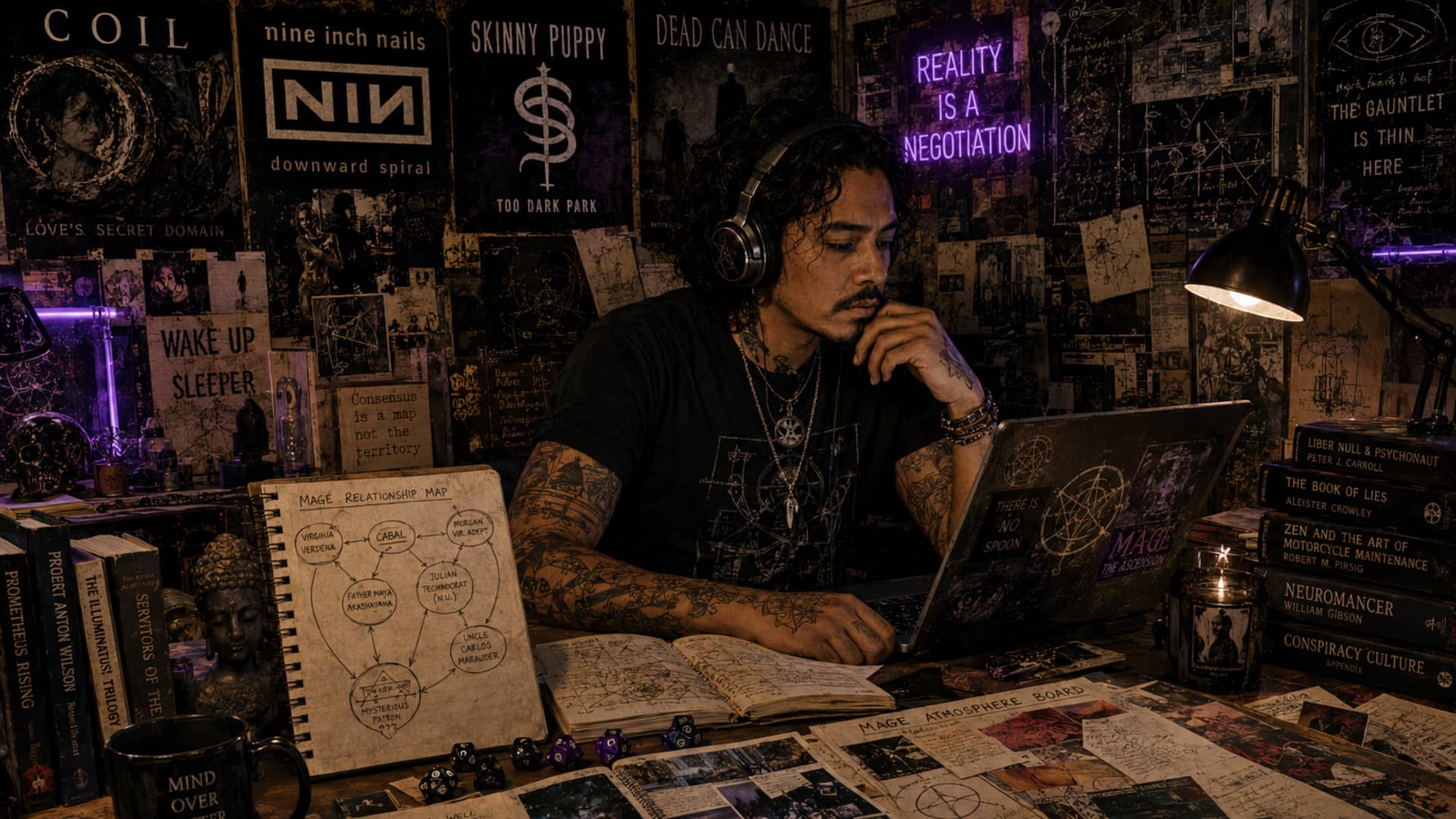
5. Relationship Map

Mage chronicles become easier to run when you can see who wants what.

A relationship map tracks:

  • Player cabal members
  • Mentors
  • Rivals
  • Chantry leadership
  • Technocracy agents
  • Sleepers
  • Cults
  • Spirits
  • Nephandi
  • Marauders
  • Vampires, werewolves, ghosts, or other crossover forces
  • Debts, secrets, alliances, betrayals, and favors

This is especially useful because Mage is rarely just about combat.

It is about pressure.

Who is watching the cabal? Who is using them? Who wants them protected? Who wants them erased? Who thinks they are useful but expendable?

A relationship map turns your chronicle into a web. Tug one strand and the whole city moves.

6. Faction Agenda Sheet

Every major faction should have three things:

  • A belief
  • A goal
  • A line they will not cross

The Traditions, Technocracy, Crafts, Nephandi, Marauders, and local factions all become more useful when they are treated as living organizations instead of lore entries.

For each faction, write:

  • What do they believe?
  • What do they want in this city?
  • What resources do they control?
  • What are they afraid of?
  • What are they hiding?
  • What would make them cooperate with the cabal?
  • What would make them betray the cabal?
  • What do they misunderstand?

The strongest Mage antagonists usually believe they are saving the world. That is what makes them dangerous.

7. Paradox Consequence Table

Paradox should not feel like a parking ticket from reality. It should feel like reality noticing.

A Paradox Consequence Table can help you improvise effects that fit the tone of your chronicle.

Consequences might include:

  • Strange coincidences
  • Dreams that bleed into waking life
  • Temporary sensory distortions
  • Bad luck
  • Spirit attention
  • Technocratic detection
  • Witnesses remembering things differently
  • Reality scars
  • Symbolic backlash
  • Paradox spirits
  • Removal into a Paradox Realm

The goal is not to punish creativity. The goal is to remind players that magic has weight.

8. Scene Framing Checklist

Mage sessions can sprawl. That is not always bad, but a checklist helps every scene carry weight.

Before a scene starts, ask:

  • What is the purpose of this scene?
  • What does the cabal want?
  • What does someone else want?
  • What new information can be discovered?
  • What choice can be made?
  • What might change afterward?
  • What sensory detail makes this feel like Mage?

That last one matters.

A flickering fluorescent light. A saint card tucked into a server rack. A homeless prophet reciting stock prices. A rainstorm that only falls on one building. A mirror that reflects the room from yesterday.

Mage lives in details like that.

9. Mystery Tracker

Mage loves secrets. But secrets need structure.

Use a Mystery Tracker to organize:

  • Core mystery
  • Surface clues
  • Hidden clues
  • False leads
  • NPCs who know partial truths
  • What the Technocracy thinks is happening
  • What the Traditions think is happening
  • What is actually happening
  • What happens if the cabal does nothing

The best Mage mysteries are not puzzles with one correct answer.

They are realities under negotiation.

10. Atmosphere Board

Your chronicle should have a mood.

Build a simple atmosphere board with:

  • Images
  • Music
  • Films
  • Colors
  • Locations
  • Symbols
  • Quotes
  • Fashion
  • Architecture
  • Album covers
  • News clippings
  • Conspiracy diagrams
  • Occult art
  • Technology references

This gives everyone a shared visual and emotional language.

A Virtual Adept chronicle should not feel like a Verbena chronicle. A Chicago street-level mystery should not feel like an Umbrood pilgrimage.

Your atmosphere board helps the table enter the same world.

11. NPC Card Template

Mage NPCs should be easy to run.

For each important NPC, write:

  • Name
  • Faction
  • Role
  • Public face
  • Private agenda
  • Magical style
  • What they want from the cabal
  • What they can offer
  • What they are hiding
  • One memorable detail

Do not overstat them. Make them playable. One great detail is better than three pages of biography.

12. After-Session Debrief

After every session, write down:

  • What changed?
  • What did the players care about?
  • Which NPCs landed?
  • What questions did they ask?
  • What consequences are now in motion?
  • What did they misunderstand in an interesting way?
  • What should return later?

This is how you make the chronicle feel responsive.

Mage works best when players sense the world reacting to them.

Not because the Storyteller planned everything. Because the Storyteller was listening.

The Tool Is Not the Game

None of these tools are required.

You can run Mage with a book, some dice, and a group of people willing to chase impossible ideas.

But tools help.

They reduce friction. They organize complexity. They make it easier to preserve what makes Mage beautiful without getting lost in the machinery.

Use what helps. Ignore what does not. Hack the rest.

That is also Mage.

Keep Building the Toolkit

If you want to keep going, start with these Mage: The Podcast resources:

Mage is a game about changing reality.

The right tools help you make that reality easier to enter, stranger to explore, and harder to forget.

Contact us at magethepodcast@gmail.com with feedback and comments, and please help extend the reach of the show by sharing it with friends.

Follow Us

Listen on Apple Podcasts, Spotify, YouTube, or your favorite podcast app.

Join our Discord server.

Reality Deviants Book Club: Arthur Machen

Reality Deviants Book Club: Arthur Machen

Adam and Pooka discuss the weird fiction of Arthur Machen, Welshman extraordinaire. Do turn of the century horror stories offer anything to modern Mage games? Is this a boon to Victorian Mage Storytellers? Do the powers of darkness really want to redecorate your office? Tune in & hear story ideas, horror commentary and hermetic code names.

📄 Transcript of Reality Deviants Book Club: Arthur Machen

Show Notes

Executive Producers

Oracles

Bad Company • Buck Gregory • Christopher Phillips • Derek Semsick • DrawnCap • DrunkDez • Jason Vines • Rebecca Pool • Sean Gallagher • Spartacus • The Krewe of Erebuss

Archmasters

Berto • Brad-O-the Blue • Dan Svensson • Glacial Indifference • Jeffois • Leroy Bryce • Morgan Aran • Wolf Larryson

Acolytes

Aleks • Alexia • Ambiversion • Anders S • Ben Bandelow • Blaise Hebert • Bruno Teixeira • Bryce Perry • Bubba, The Pale One • Chartan • Cig • Curtis Hendricks • Darren Hennessey • Daniel Cuppen • Daniel Scribner • Dan Svensson • David Röhe • Ean Robertson • EBG • Eric Schwenke • Gray -Trilug- H • Guy Stewart • Ia Bull • James B • Jason Kennedy • Jenna F • Jeremy Z • Jervis Johnson • Kathleen Hailperin • Kevin Fitzpatrick • Khris Kinner • Leslie Weatherstone • Lolz & stuff • Loren Jensen • Manel Canós • Matthew Proehl • Maurice Hopkins • Melissa Krause • Michael Parker • Nebero • Nikita Kleymenov • Patrick McNamara • RobH • Ryan • Ryan Kendy • Ryan Stray • Samuel Tobin • Sev Nessus • Shell Konch • Starfish • Stefan Carton • Tyler Bryan • Will Vincent • Ygard

Become a supporter of Mage: The Podcast.

Contact us at magethepodcast@gmail.com with feedback and comments, and please help extend the reach of the show by sharing it with friends.

Follow Us

Listen on Apple Podcasts, Spotify, YouTube, or your favorite podcast app.

Join our Discord server.

Media Club: Buckaroo Banzai

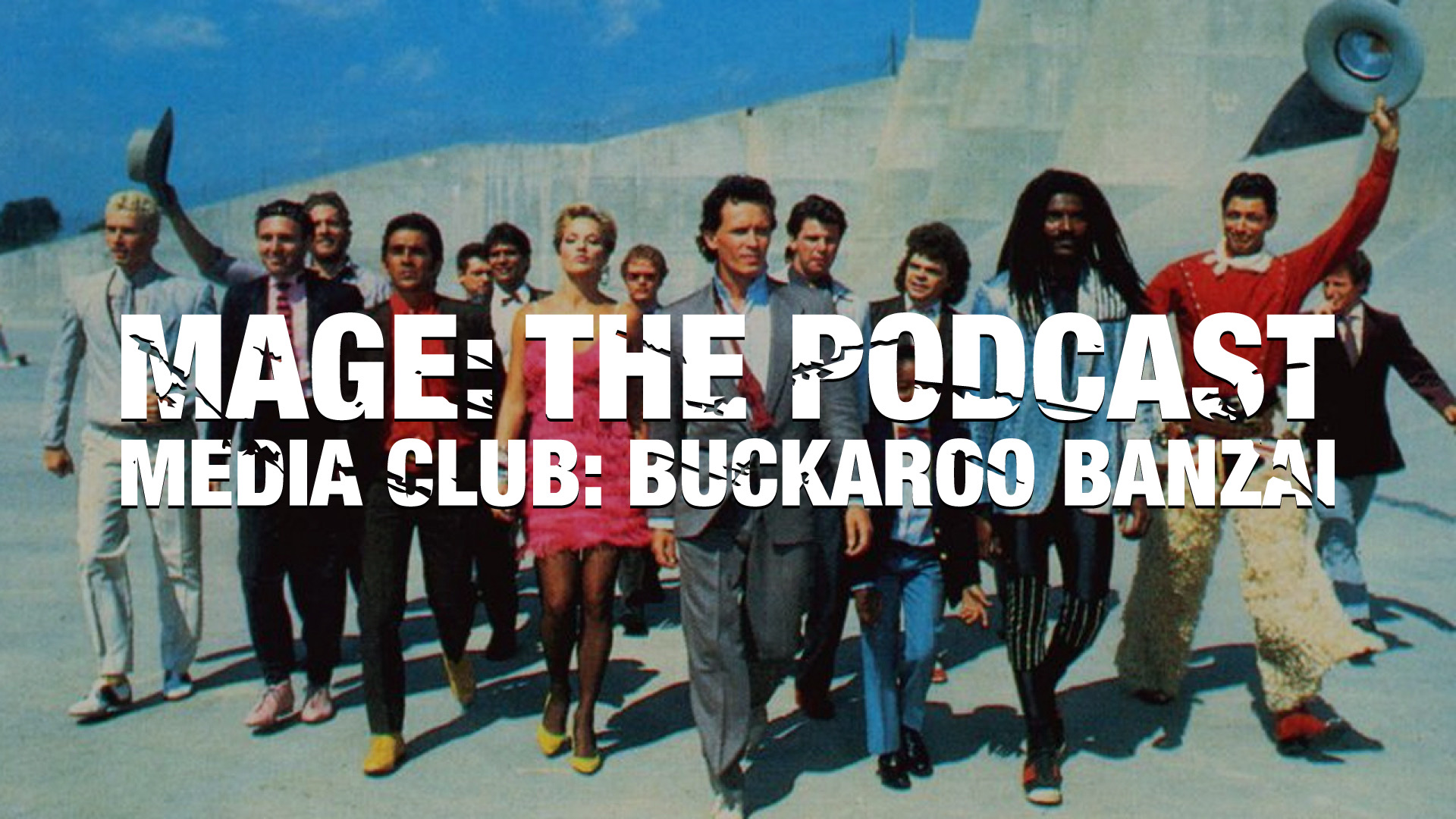
Media Club: Buckaroo Banzai

Adam, Jenna, and Pooka take a gleeful ride through The Adventures of Buckaroo Banzai Across the 8th Dimension, celebrating its pulpy charm, wild 80s style, oddball science, and Mage-ready Etherite energy. They cover what works, what wobbles, how to “Mage-ify” it, and why this messy cult classic still sparks game ideas, big laughs, and deep affection.

📄 Transcript of Media Club: Buckaroo Banzai

Show Notes

Executive Producers

Oracles

Bad Company • Buck Gregory • Christopher Phillips • Derek Semsick • DrawnCap • DrunkDez • Jason Vines • Rebecca Pool • Sean Gallagher • Spartacus • The Krewe of Erebuss

Archmasters

Berto • Brad-O-the Blue • Dan Svensson • Glacial Indifference • Jeffois • Leroy Bryce • Morgan Aran • Wolf Larryson

Acolytes

Aleks • Alexia • Ambiversion • Anders S • Ben Bandelow • Blaise Hebert • Bruno Teixeira • Bryce Perry • Bubba, The Pale One • Chartan • Cig • Curtis Hendricks • Darren Hennessey • Daniel Cuppen • Daniel Scribner • Dan Svensson • David Röhe • Ean Robertson • EBG • Eric Schwenke • Gray -Trilug- H • Guy Stewart • Ia Bull • James B • Jason Kennedy • Jenna F • Jeremy Z • Jervis Johnson • Kathleen Hailperin • Kevin Fitzpatrick • Khris Kinner • Leslie Weatherstone • Lolz & stuff • Loren Jensen • Manel Canós • Matthew Proehl • Maurice Hopkins • Melissa Krause • Michael Parker • Nebero • Nikita Kleymenov • Patrick McNamara • RobH • Ryan • Ryan Kendy • Ryan Stray • Samuel Tobin • Sev Nessus • Shell Konch • Starfish • Stefan Carton • Tyler Bryan • Will Vincent • Ygard

Become a supporter of Mage: The Podcast.

Contact us at magethepodcast@gmail.com with feedback and comments, and please help extend the reach of the show by sharing it with friends.

Follow Us

Listen on Apple Podcasts, Spotify, YouTube, or your favorite podcast app.

Join our Discord server.