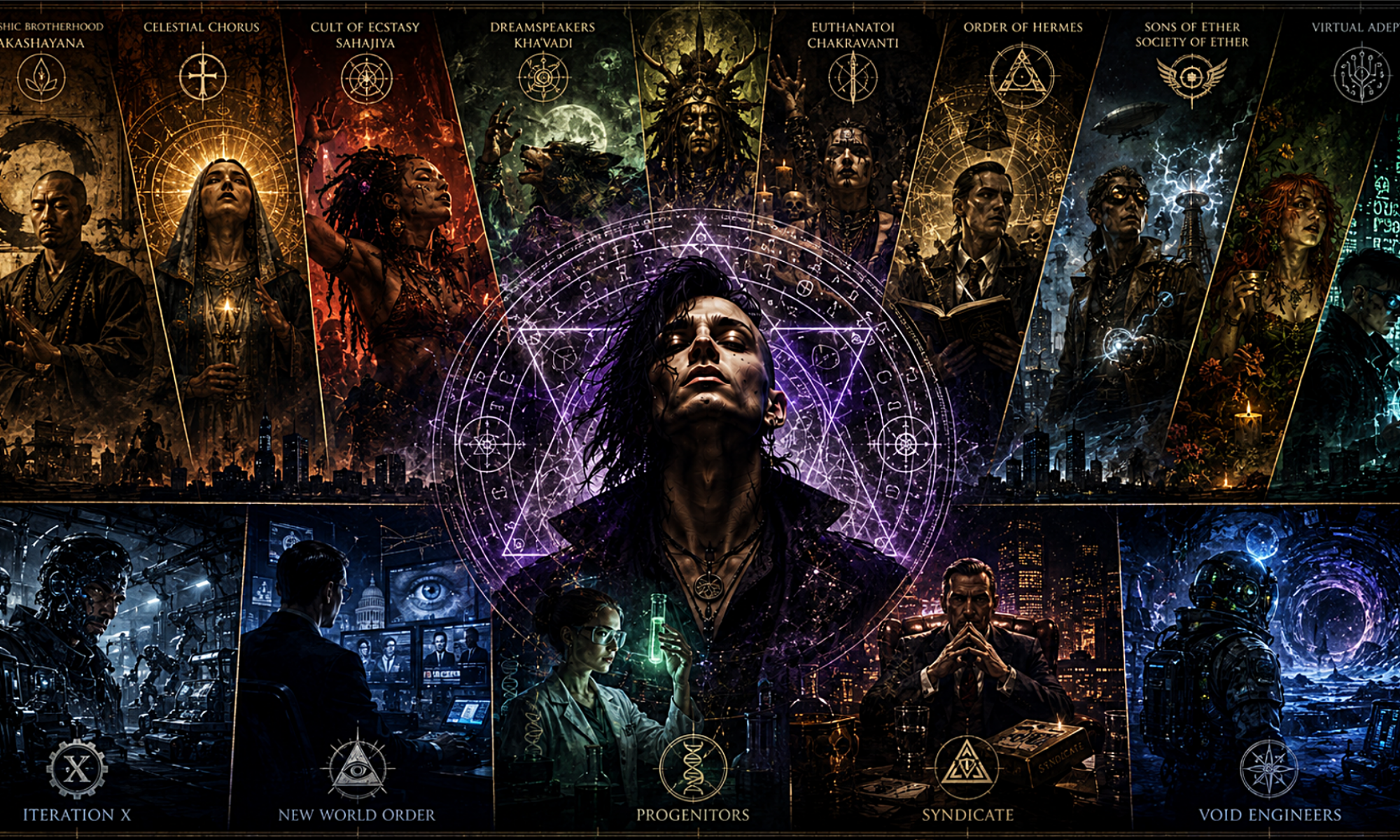
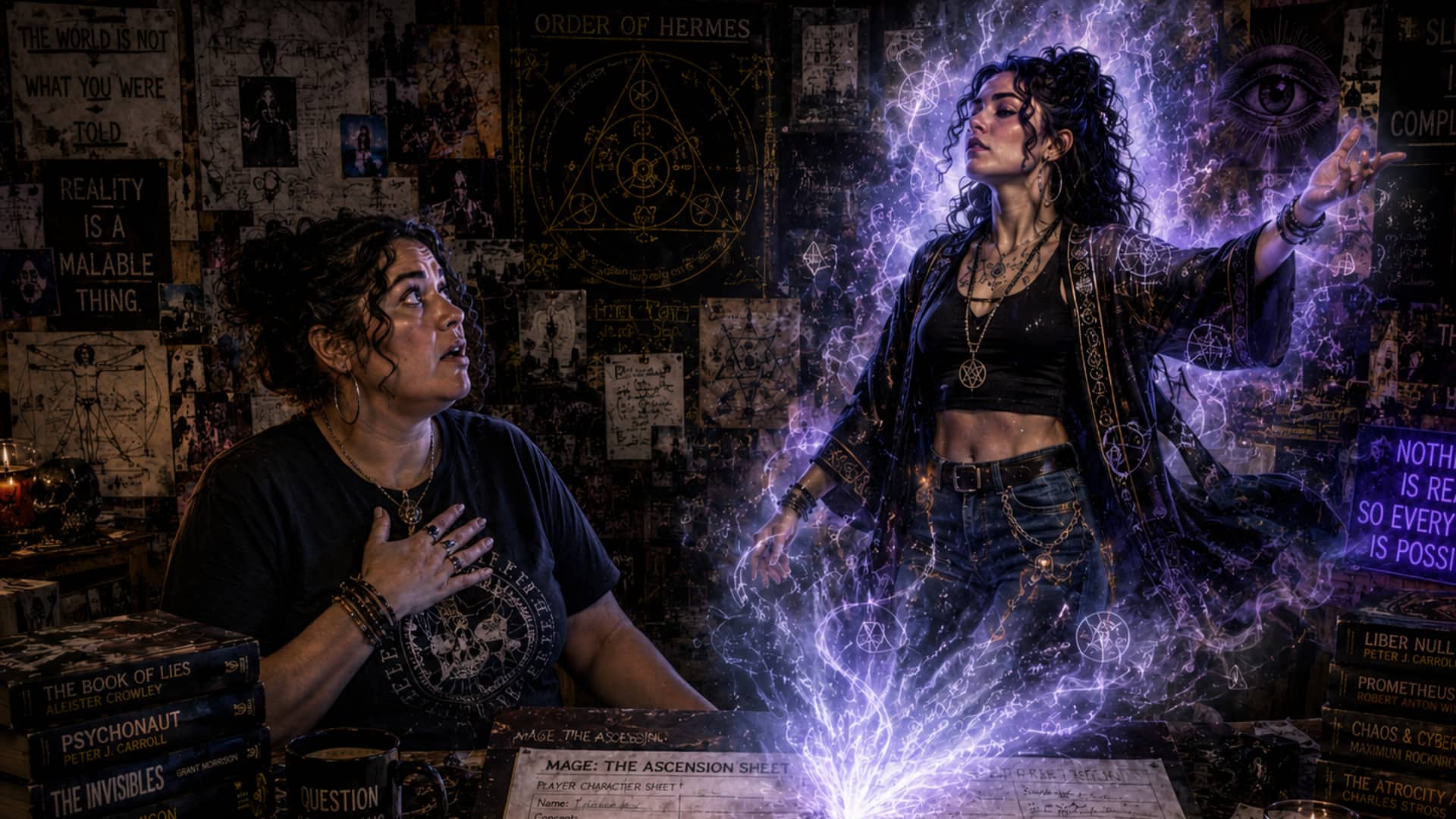
Mage characters are more than stats.
The best ones have beliefs, contradictions, obsessions, mentors, enemies, tools, rituals, and a theory of reality that can get them into trouble.
That is what makes character creation in Mage: The Ascension so rewarding. It is also what makes it difficult.
You are not just choosing dots on a sheet. You are building someone who looked at reality, saw the seams, and decided they could pull.
Start With Belief
Before you choose Spheres, ask:
What does this character believe is true?
Not what they know. Not what their Tradition teaches. What do they believe so deeply that magic can move through it?
A Mage character should have a worldview. Maybe they believe reality is code.
Maybe they believe the world is a living organism. Maybe they believe every human soul is a divine fragment. Maybe they believe language traps possibility. Maybe they believe the universe is a machine, a song, a wound, a joke, or a prison.
That belief is not flavor text.
It is the engine.
The Core Character Questions
Use these before touching the character sheet:
- What did your character believe before Awakening?
- What happened that made them realize reality was not fixed?
- What did Awakening cost them?
- Who taught them how magic works?
- Who thinks they are dangerous?
- What do they want badly enough to risk Paradox?
- What part of their worldview is wrong?
- What kind of magic feels natural to them?
- What kind of magic disgusts or frightens them?
- What would make them betray their own beliefs?
If you can answer those, the dots become easier.
Build a Contradiction
Great Mage characters are not perfectly coherent. They are human. Give them a contradiction.
Examples:
- A Virtual Adept who hates being watched but cannot stop surveilling others
- A Verbena healer who is terrified of death
- A Hermetic who craves control but keeps falling in love with chaos
- A Chorister who believes in divine unity but cannot forgive one person
- A Technocrat who protects Sleepers but no longer believes the Union tells the truth
- An Ecstatic who preaches freedom but keeps manipulating their friends
- An Etherite who wants wonder but needs recognition
Contradictions create drama. They give the Storyteller something to challenge.
Choose an Obsession
Mage characters should want something. Not casually. Dangerously. An obsession gives the character momentum.
They might be obsessed with:
- Finding their missing mentor
- Proving their theory of reality
- Destroying a Technocratic construct
- Saving their neighborhood
- Reaching the Umbra
- Understanding their Avatar
- Exposing a conspiracy
- Awakening someone they love
- Finding a lost grimoire
- Undoing one terrible mistake
Obsession is useful because it answers the question:
Why does this character not just stay home?
Make the Avatar Personal
An Avatar should not feel like a generic power source. It should feel like pressure.
Ask:
- How does the Avatar communicate?
- Does it appear in dreams?
- Does it speak?
- Does it use symbols?
- Does it feel loving, cruel, distant, hungry, playful, or alien?
- What does it want?
- What does it keep pushing the character toward?
- What does the character fear it might really be?
The Avatar does not need to explain itself. In fact, it is often better when it does not.
Define Paradigm in Plain Language
Paradigm can feel intimidating, so simplify it.
Ask the player to finish this sentence:
Magic works because…
Examples:
- Magic works because reality is made of information.
- Magic works because the gods never left.
- Magic works because the body remembers what the mind denies.
- Magic works because machines are rituals with better branding.
- Magic works because consciousness shapes probability.
- Magic works because everything is connected through divine love.
- Magic works because the world is a lie with weak security.
Once a player can say that, they have the beginning of a Paradigm.
Give Them Tools and Rituals
Mage magic should feel embodied. What does the character actually do?
Their Focus might include:
- Prayer
- Dance
- Coding
- Blood
- Tarot
- Street art
- Equations
- Drugs
- Martial arts
- Meditation
- Hacking tools
- Sacred geometry
- Music
- Tattoos
- Cooking
- Fashion
- Corporate procedure
- Medical equipment
- Surveillance systems
The more specific the tools, the more memorable the magic. Not “I use Forces.”
Instead:
“I tune a busted police scanner to the frequency of a thunderstorm and speak the name of the first fire.”
That feels like Mage.
Create a Mentor
Every Mage needs someone who shaped them. A mentor can be loving, abusive, brilliant, absent, dead, manipulative, unreliable, or all of the above.
Ask:
- Who taught the character?
- What did they teach well?
- What did they hide?
- What do they still want?
- What does the character owe them?
- What warning did they give?
- What did they get completely wrong?
A mentor gives the Storyteller instant story material.
Create an Enemy
An enemy does not have to be a villain. The best enemies often think they are right.
Ask:
- Who wants this character stopped?
- Who thinks they are wasting their gift?
- Who envies them?
- Who fears what they might become?
- Who did they hurt during or after Awakening?
- Who knows their secret?
- Who wants to recruit them instead of destroy them?
An enemy gives the character tension before the chronicle even begins.
Connect Them to the Cabal
Mage is better when characters are tied together before play starts. Ask each player to connect their character to at least two others.
Possible connections:
- We shared an Awakening experience.
- We escaped the same enemy.
- We studied under the same mentor.
- I owe you my life.
- I do not trust you, but I need you.
- We loved the same person.
- We saw the same impossible thing.
- We disagree about everything except the mission.
- You know what I did.
- I know what you are becoming.
A cabal does not need harmony. It needs weight.
Let Spheres Follow Concept
New players often start with Spheres. Try reversing that.
Start with:
- Belief
- Obsession
- Tools
- Mentor
- Enemy
- Cabal role
- Magical style
Then choose Spheres that support the character.
A street prophet who hears the city dreaming may naturally lean toward Correspondence, Mind, Spirit, or Entropy.
A biotech body-hacker might lean Life, Matter, Forces, or Data-flavored Correspondence.
A grief-haunted medium may need Spirit, Entropy, Time, or Mind.
The Spheres should feel like an expression of the character, not a shopping list.
Character Creation Worksheet
Use this as a quick aid.
Identity
Name:
Age:
Concept:
Tradition, Craft, Convention, or Orphan:
Role:
Belief
Magic works because:
Reality is:
Sleepers are wrong about:
My character is wrong about:
Awakening
What happened?
Who was there?
What changed afterward?
What did it cost?
Practice
Tools:
Rituals:
Symbols:
What coincidental magic looks like:
What vulgar magic looks like:
Relationships
Mentor:
Rival:
Enemy:
Sleeper connection:
Person I owe:
Person who owes me:
Cabal connection:
Trouble
Obsession:
Temptation:
Fear:
Secret:
Line I will not cross:
Line I might cross:
Common Character Creation Mistakes
Making a Power Set Instead of a Person
A Mage character is not “Forces 3, Prime 2.” That is what they can do. It is not who they are.
Making Paradigm Too Vague
“Energy manipulation” is less useful than “all matter is trapped music, and I know how to change the song.” Specificity creates better scenes.
Ignoring Sleepers
A mage with no Sleeper ties is easier to write but often less interesting.
Give them family, friends, jobs, debts, habits, and people who still think they are normal.
Avoiding Consequences
Mage characters should be dangerous to themselves.
Let them want things. Let them be wrong. Let their magic create problems.
That is where the story gets good.
Recommended Mage: The Podcast Episodes and Resources
These pair well with character creation:
- What Is Mage: The Ascension?
- One Dot Sphere Effects
- Tomes of Magick: Guide to the Traditions
- The Perils of Paradox
- Plot Hooks
- Podcast Archive
The Goal Is Not a Perfect Character
The goal is a playable contradiction.
Someone with beliefs strong enough to bend reality and flaws strong enough to make that dangerous. Someone with tools, rituals, debts, enemies, mentors, and questions. Someone who does not just cast magic. Someone whose magic reveals who they are.
Because in Mage, character creation is not only about deciding what your mage can do. It is about deciding what kind of reality they are willing to fight for.
And what kind of reality might fight back.
Contact us at magethepodcast@gmail.com with feedback and comments, and please help extend the reach of the show by sharing it with friends.
Follow Us
Listen on Apple Podcasts, Spotify, YouTube, or your favorite podcast app.
Join our Discord server.
Discover more from Mage: The Podcast
Subscribe to get the latest posts sent to your email.