Such Pain

Such Pain

Pooka and Lee discuss Such Pain, the first Mage novel published in 1995.  Can novel-length stories help you envision the world of Mage?  Did the author hit it out of the park with this one?  Hear Pooka and Lee’s review of the book.  Their commentary highlights how the World of Darkness was a little different during Mage’s first edition.

Show Notes

  • Such Pain – Playboy Aaron Barry inherits an empire, fires his father’s allies, courts a reporter, and returns to a haunted home he fears.
  • Don Bassingthwaite – Born in Ontario, Bassingthwaite excelled in school, won awards, studied anthropology at Toronto, and began a publishing career while playing D&D.
  • Truth Until Paradox (short story collection) – Reality is mutable; mages shape it. In a dark mirror of our world, stories explore power, truth, and rival visions of Ascension.
  • Mage: The Ascension (RPG) – ou play reality-bending mages using belief to shape the world while battling rival factions and risking paradox.
  • Dragonlance Chronicles – Dragons return to Krynn, bringing war. A band of friends—knight, mage, and more—rise as unlikely heroes to seek the legendary Dragonlance.
  • The Holy Mountain – 1973 surreal film by Alejandro Jodorowsky, funded by John Lennon and Yoko Ono; shown at festivals like Cannes Film Festival. A Christ-like thief meets an alchemist, joins seekers, and climbs a holy mountain, only to learn the quest is illusion and reality lies beyond.

Executive Producers

Oracles

Bad Company • Buck Gregory • Christopher Phillips • Derek Semsick • DrawnCap • DrunkDez • Jason Vines • Rebecca Pool • Sean Gallagher • Spartacus • The Krewe of Erebuss

Archmasters

Berto • Brad-O-the Blue • Dan Svensson • Glacial Indifference • Jeffois • Leroy Bryce • Morgan Aran • Wolf Larryson

Acolytes

Aleks • Alexia • Ambiversion • Anders S • Ben Bandelow • Blaise Hebert • Bruno Teixeira • Bryce Perry • Bubba, The Pale One • Chartan • Cig • Curtis Hendricks • Darren Hennessey • Daniel Cuppen • Daniel Scribner • Dan Svensson • David Röhe • Ean Robertson • EBG • Eric Schwenke • Gray -Trilug- H • Guy Stewart • Ia Bull • James B • Jason Kennedy • Jenna F • Jeremy Z • Jervis Johnson • Kathleen Hailperin • Kevin Fitzpatrick • Khris Kinner • Leslie Weatherstone • Lolz & stuff • Loren Jensen • Manel Canós • Matthew Proehl • Maurice Hopkins • Melissa Krause • Michael Parker • Nebero • Nikita Kleymenov • Patrick McNamara • RobH • Ryan • Ryan Kendy • Ryan Stray • Samuel Tobin • Sev Nessus • Shell Konch • Starfish • Stefan Carton • Tyler Bryan • Will Vincent • Ygard

Become a supporter of Mage: The Podcast.

Contact us at magethepodcast@gmail.com with feedback and comments, and please help extend the reach of the show by sharing it with friends.

Follow Us

Listen on Apple Podcasts, Spotify, YouTube, or your favorite podcast app.

Join our Discord server.

Storytelling Tools for Mage: The Ascension

Mage: The Ascension is not a game that rewards overplanning. It rewards preparation. That difference matters.

Overplanning says, “Here is the story my players will follow.”

Preparation says, “Here is a living world full of beliefs, factions, mysteries, consequences, and dangerous choices. Let’s see what happens when the cabal touches it.”

That is where Storytelling Tools come in. Not tools that make Mage smaller. Tools that make Mage playable.

Why Mage Needs Storytelling Tools

Mage is rich, strange, philosophical, contradictory, and occasionally overwhelming. That is part of its charm. It is also why a Storyteller can sit down with the core book, stare at hundreds of pages of brilliant material, and wonder: “Okay. But what do I actually run on Friday?”

Storytelling Tools help bridge the gap between big ideas and table play.

They turn themes into sessions. They turn factions into conflicts. They turn character beliefs into drama. They turn “reality is negotiable” into something your players can actually experience.

1. Session Zero Worksheet

Every Mage chronicle should begin with a conversation.

Before anyone chooses Spheres, before anyone builds a cabal, before anyone starts arguing about whether a smartphone counts as a Focus, the group needs to answer one question: What kind of Mage game are we playing?

A Session Zero worksheet can help establish:

  • Chronicle tone
  • Street-level or cosmic scale
  • Traditions, Technocracy, Orphans, or mixed cabal
  • Level of horror
  • Expected weirdness
  • Use of Paradox
  • Safety tools and boundaries
  • Player goals
  • Character connections
  • How much rules precision the table wants

Mage can be occult horror, philosophical conspiracy, urban fantasy, political thriller, cosmic weirdness, or personal awakening.

Your table needs to know which door it is opening.

2. Chronicle Planning Sheet

A good Mage chronicle does not start with a villain. It starts with a question.

Try building your chronicle around one of these:

  • Who controls reality in this city?
  • What lie keeps the peace?
  • What truth would destroy the cabal?
  • What does the Technocracy protect that the Traditions refuse to understand?
  • What price does Awakening demand?
  • What happens when a player’s Paradigm is wrong, incomplete, or dangerous?

A Chronicle Planning Sheet should include:

  • Central theme
  • Primary city or setting
  • Main factions
  • Major mysteries
  • Key NPCs
  • Nodes, chantries, constructs, and sacred spaces
  • Recurring symbols
  • Tone references
  • Opening situation
  • Escalation path
  • Possible consequences

Do not write the ending. Write pressure. Then let the players create the explosion.

3. Character Belief Questionnaire

Mage characters are not just people with powers. They are people with a theory of reality. That theory should matter.

A Character Belief Questionnaire can ask:

  • What does your character believe is fundamentally true?
  • What do they think most Sleepers misunderstand?
  • What did Awakening cost them?
  • Who taught them how the world works?
  • What would make them doubt their Paradigm?
  • What kind of magic feels natural to them?
  • What kind of magic feels offensive, false, or dangerous?
  • Who do they trust?
  • Who do they owe?
  • What do they want badly enough to risk Paradox?

This tool helps players build mages who are more than Sphere combinations.

It gives the Storyteller levers to pull.

4. Paradigm and Focus Worksheet

Paradigm is one of the best parts of Mage. It is also one of the easiest parts to flatten.

A good worksheet helps players move from vague concepts like “chaos magician” or “techno-wizard” into specific practices.

Ask:

  • What does your character believe magic is?
  • Where does power come from?
  • Why does their magic work?
  • What tools, rituals, technologies, prayers, movements, or symbols do they use?
  • What would make their magic fail?
  • What does vulgar magic look like for them?
  • What does coincidental magic look like?
  • How do they explain Paradox?

Once a player can answer those questions, magic becomes personal.

Not just “I roll Forces.”

But “I reroute the city’s electrical grid through a stolen saint’s relic and a broken pager because all systems are prayers if enough people depend on them.”

That is Mage.

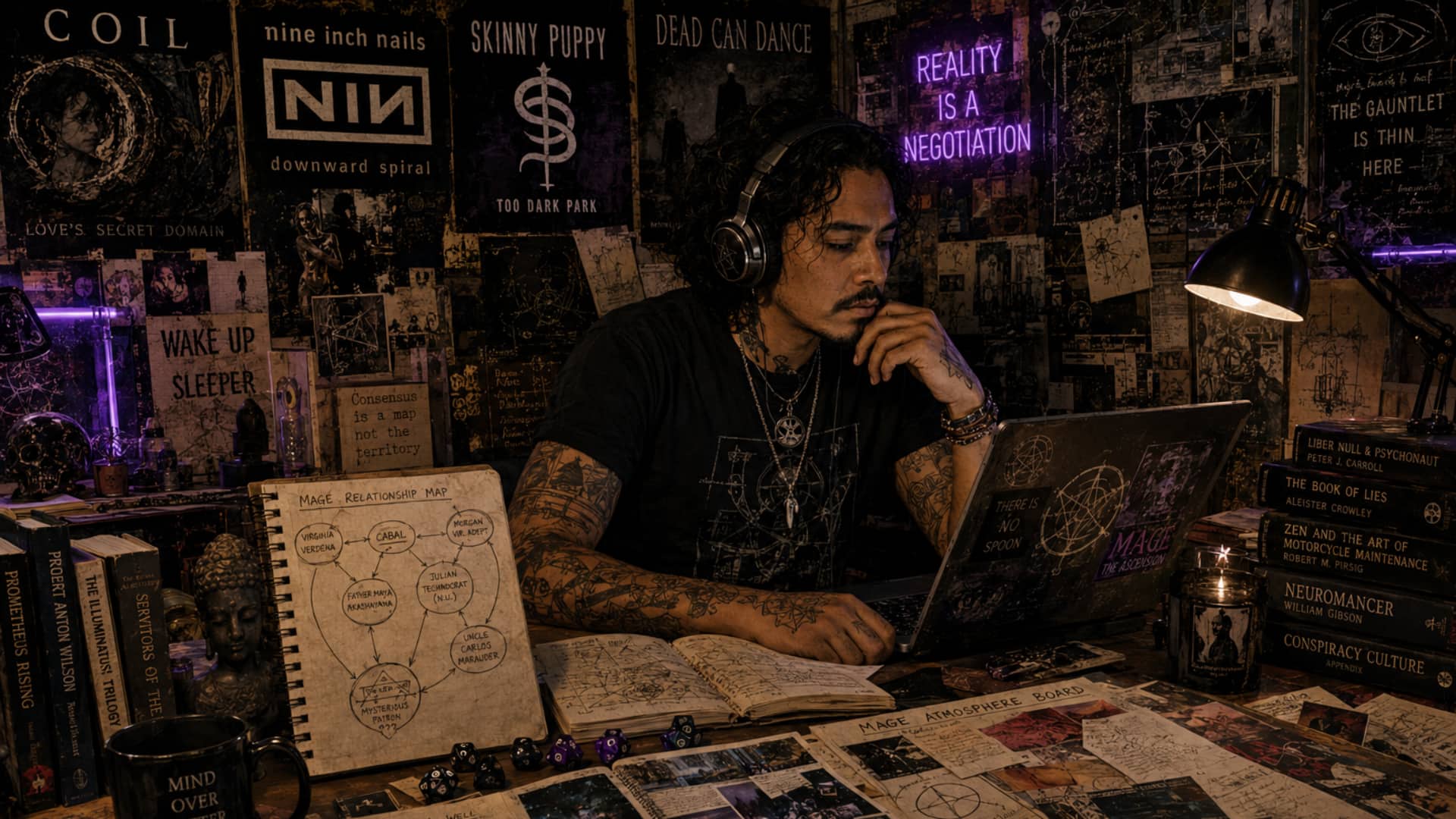
5. Relationship Map

Mage chronicles become easier to run when you can see who wants what.

A relationship map tracks:

  • Player cabal members
  • Mentors
  • Rivals
  • Chantry leadership
  • Technocracy agents
  • Sleepers
  • Cults
  • Spirits
  • Nephandi
  • Marauders
  • Vampires, werewolves, ghosts, or other crossover forces
  • Debts, secrets, alliances, betrayals, and favors

This is especially useful because Mage is rarely just about combat.

It is about pressure.

Who is watching the cabal? Who is using them? Who wants them protected? Who wants them erased? Who thinks they are useful but expendable?

A relationship map turns your chronicle into a web. Tug one strand and the whole city moves.

6. Faction Agenda Sheet

Every major faction should have three things:

  • A belief
  • A goal
  • A line they will not cross

The Traditions, Technocracy, Crafts, Nephandi, Marauders, and local factions all become more useful when they are treated as living organizations instead of lore entries.

For each faction, write:

  • What do they believe?
  • What do they want in this city?
  • What resources do they control?
  • What are they afraid of?
  • What are they hiding?
  • What would make them cooperate with the cabal?
  • What would make them betray the cabal?
  • What do they misunderstand?

The strongest Mage antagonists usually believe they are saving the world. That is what makes them dangerous.

7. Paradox Consequence Table

Paradox should not feel like a parking ticket from reality. It should feel like reality noticing.

A Paradox Consequence Table can help you improvise effects that fit the tone of your chronicle.

Consequences might include:

  • Strange coincidences
  • Dreams that bleed into waking life
  • Temporary sensory distortions
  • Bad luck
  • Spirit attention
  • Technocratic detection
  • Witnesses remembering things differently
  • Reality scars
  • Symbolic backlash
  • Paradox spirits
  • Removal into a Paradox Realm

The goal is not to punish creativity. The goal is to remind players that magic has weight.

8. Scene Framing Checklist

Mage sessions can sprawl. That is not always bad, but a checklist helps every scene carry weight.

Before a scene starts, ask:

  • What is the purpose of this scene?
  • What does the cabal want?
  • What does someone else want?
  • What new information can be discovered?
  • What choice can be made?
  • What might change afterward?
  • What sensory detail makes this feel like Mage?

That last one matters.

A flickering fluorescent light. A saint card tucked into a server rack. A homeless prophet reciting stock prices. A rainstorm that only falls on one building. A mirror that reflects the room from yesterday.

Mage lives in details like that.

9. Mystery Tracker

Mage loves secrets. But secrets need structure.

Use a Mystery Tracker to organize:

  • Core mystery
  • Surface clues
  • Hidden clues
  • False leads
  • NPCs who know partial truths
  • What the Technocracy thinks is happening
  • What the Traditions think is happening
  • What is actually happening
  • What happens if the cabal does nothing

The best Mage mysteries are not puzzles with one correct answer.

They are realities under negotiation.

10. Atmosphere Board

Your chronicle should have a mood.

Build a simple atmosphere board with:

  • Images
  • Music
  • Films
  • Colors
  • Locations
  • Symbols
  • Quotes
  • Fashion
  • Architecture
  • Album covers
  • News clippings
  • Conspiracy diagrams
  • Occult art
  • Technology references

This gives everyone a shared visual and emotional language.

A Virtual Adept chronicle should not feel like a Verbena chronicle. A Chicago street-level mystery should not feel like an Umbrood pilgrimage.

Your atmosphere board helps the table enter the same world.

11. NPC Card Template

Mage NPCs should be easy to run.

For each important NPC, write:

  • Name
  • Faction
  • Role
  • Public face
  • Private agenda
  • Magical style
  • What they want from the cabal
  • What they can offer
  • What they are hiding
  • One memorable detail

Do not overstat them. Make them playable. One great detail is better than three pages of biography.

12. After-Session Debrief

After every session, write down:

  • What changed?
  • What did the players care about?
  • Which NPCs landed?
  • What questions did they ask?
  • What consequences are now in motion?
  • What did they misunderstand in an interesting way?
  • What should return later?

This is how you make the chronicle feel responsive.

Mage works best when players sense the world reacting to them.

Not because the Storyteller planned everything. Because the Storyteller was listening.

The Tool Is Not the Game

None of these tools are required.

You can run Mage with a book, some dice, and a group of people willing to chase impossible ideas.

But tools help.

They reduce friction. They organize complexity. They make it easier to preserve what makes Mage beautiful without getting lost in the machinery.

Use what helps. Ignore what does not. Hack the rest.

That is also Mage.

Keep Building the Toolkit

If you want to keep going, start with these Mage: The Podcast resources:

Mage is a game about changing reality.

The right tools help you make that reality easier to enter, stranger to explore, and harder to forget.

Contact us at magethepodcast@gmail.com with feedback and comments, and please help extend the reach of the show by sharing it with friends.

Follow Us

Listen on Apple Podcasts, Spotify, YouTube, or your favorite podcast app.

Join our Discord server.

Reality Deviants Book Club: Arthur Machen

Reality Deviants Book Club: Arthur Machen

Adam and Pooka discuss the weird fiction of Arthur Machen, Welshman extraordinaire. Do turn of the century horror stories offer anything to modern Mage games? Is this a boon to Victorian Mage Storytellers? Do the powers of darkness really want to redecorate your office? Tune in & hear story ideas, horror commentary and hermetic code names.

📄 Transcript of Reality Deviants Book Club: Arthur Machen

Show Notes

Executive Producers

Oracles

Bad Company • Buck Gregory • Christopher Phillips • Derek Semsick • DrawnCap • DrunkDez • Jason Vines • Rebecca Pool • Sean Gallagher • Spartacus • The Krewe of Erebuss

Archmasters

Berto • Brad-O-the Blue • Dan Svensson • Glacial Indifference • Jeffois • Leroy Bryce • Morgan Aran • Wolf Larryson

Acolytes

Aleks • Alexia • Ambiversion • Anders S • Ben Bandelow • Blaise Hebert • Bruno Teixeira • Bryce Perry • Bubba, The Pale One • Chartan • Cig • Curtis Hendricks • Darren Hennessey • Daniel Cuppen • Daniel Scribner • Dan Svensson • David Röhe • Ean Robertson • EBG • Eric Schwenke • Gray -Trilug- H • Guy Stewart • Ia Bull • James B • Jason Kennedy • Jenna F • Jeremy Z • Jervis Johnson • Kathleen Hailperin • Kevin Fitzpatrick • Khris Kinner • Leslie Weatherstone • Lolz & stuff • Loren Jensen • Manel Canós • Matthew Proehl • Maurice Hopkins • Melissa Krause • Michael Parker • Nebero • Nikita Kleymenov • Patrick McNamara • RobH • Ryan • Ryan Kendy • Ryan Stray • Samuel Tobin • Sev Nessus • Shell Konch • Starfish • Stefan Carton • Tyler Bryan • Will Vincent • Ygard

Become a supporter of Mage: The Podcast.

Contact us at magethepodcast@gmail.com with feedback and comments, and please help extend the reach of the show by sharing it with friends.

Follow Us

Listen on Apple Podcasts, Spotify, YouTube, or your favorite podcast app.

Join our Discord server.

Media Club: Buckaroo Banzai

Media Club: Buckaroo Banzai

Adam, Jenna, and Pooka take a gleeful ride through The Adventures of Buckaroo Banzai Across the 8th Dimension, celebrating its pulpy charm, wild 80s style, oddball science, and Mage-ready Etherite energy. They cover what works, what wobbles, how to “Mage-ify” it, and why this messy cult classic still sparks game ideas, big laughs, and deep affection.

📄 Transcript of Media Club: Buckaroo Banzai

Show Notes

Executive Producers

Oracles

Bad Company • Buck Gregory • Christopher Phillips • Derek Semsick • DrawnCap • DrunkDez • Jason Vines • Rebecca Pool • Sean Gallagher • Spartacus • The Krewe of Erebuss

Archmasters

Berto • Brad-O-the Blue • Dan Svensson • Glacial Indifference • Jeffois • Leroy Bryce • Morgan Aran • Wolf Larryson

Acolytes

Aleks • Alexia • Ambiversion • Anders S • Ben Bandelow • Blaise Hebert • Bruno Teixeira • Bryce Perry • Bubba, The Pale One • Chartan • Cig • Curtis Hendricks • Darren Hennessey • Daniel Cuppen • Daniel Scribner • Dan Svensson • David Röhe • Ean Robertson • EBG • Eric Schwenke • Gray -Trilug- H • Guy Stewart • Ia Bull • James B • Jason Kennedy • Jenna F • Jeremy Z • Jervis Johnson • Kathleen Hailperin • Kevin Fitzpatrick • Khris Kinner • Leslie Weatherstone • Lolz & stuff • Loren Jensen • Manel Canós • Matthew Proehl • Maurice Hopkins • Melissa Krause • Michael Parker • Nebero • Nikita Kleymenov • Patrick McNamara • RobH • Ryan • Ryan Kendy • Ryan Stray • Samuel Tobin • Sev Nessus • Shell Konch • Starfish • Stefan Carton • Tyler Bryan • Will Vincent • Ygard

Become a supporter of Mage: The Podcast.

Contact us at magethepodcast@gmail.com with feedback and comments, and please help extend the reach of the show by sharing it with friends.

Follow Us

Listen on Apple Podcasts, Spotify, YouTube, or your favorite podcast app.

Join our Discord server.

Session Zero Tools for Mage: The Ascension

Session Zero Tools for Mage: The Ascension

Before the first die roll, get everyone aligned.

That sounds simple.

It is not.

Mage: The Ascension can be street-level occult mystery, cosmic horror, philosophical conspiracy, urban fantasy, Technocracy espionage, punk rebellion, spiritual awakening, or a room full of people arguing about whether reality is a prison, a dream, a machine, or a bad habit.

All of those are valid. Not all of them belong in the same chronicle. That is why Session Zero matters.

A good Session Zero does not kill mystery. It gives the mystery somewhere to grow.

What Is Session Zero?

Session Zero is the conversation before the campaign begins.

It is where players and Storytellers agree on what kind of game they are playing, what kind of experience they want, and what everyone needs to have fun.

For Mage , this is especially important because the game is big.

Very big.

Mage can handle almost anything. That does not mean your chronicle should include everything. Session Zero helps you decide what this version of Mage is going to be.

Start With the Big Question

Before character sheets, before Spheres, before factions, ask: What kind of Mage game are we actually playing?

Some possible answers:

  • Newly Awakened mages discovering the hidden world
  • Street-level occult investigation
  • Chantry politics and Tradition drama
  • Technocracy agents trying to protect the world
  • A mixed cabal caught between factions
  • Umbra exploration and spirit weirdness
  • Nephandi horror
  • Cyberpunk reality hacking
  • Magical academia
  • Punk rebellion against Consensus
  • Personal drama about belief, trauma, and transformation
  • Gonzo metaphysical chaos

None of these are wrong. But the table should know which game it is choosing.

Define the Tone

Tone is the emotional contract of the chronicle. Ask your table what the game should feel like.

Should it be:

  • Dangerous?
  • Funny?
  • Tragic?
  • Weird?
  • Romantic?
  • Political?
  • Investigative?
  • Philosophical?
  • Hopeful?
  • Bleak?
  • Personal?
  • Epic?

Mage often works best when you choose a few dominant tones rather than trying to do everything at once.

For example:

Urban occult mystery with moments of absurd cosmic horror is much clearer than everything from the Mage books.

A clear tone helps players build better characters. It also helps the Storyteller know what kind of scenes belong.

Set the Scale

Mage changes dramatically depending on scale.

A street-level chronicle about one haunted neighborhood is different from a cosmic chronicle about rewriting the rules of reality. Both can be excellent.

Ask:

  • Are we protecting one neighborhood, one city, the world, or reality itself?
  • Are the characters newly Awakened, experienced mages, or powerful Masters?
  • Are the threats local, factional, spiritual, cosmic, or personal?
  • Will the story mostly happen in the mundane world, the Umbra, Horizon Realms, or all of the above?

A smaller scale is often easier for new groups. A bigger scale can work beautifully once everyone knows what kind of Mage they want.

Talk About Safety and Boundaries

Mage can touch intense material.

For example:

  • Religion.
  • Trauma
  • Mental health
  • Cults
  • Conspiracy
  • Body horror
  • Abuse of power
  • Apocalypse
  • Possession
  • Institutional control
  • Spiritual crisis

That does not mean every table wants every subject.

Use Session Zero to discuss:

  • Lines: material that should not appear
  • Veils: material that can exist but should happen off-screen
  • Topics that need extra care
  • How players can pause or redirect a scene
  • Whether horror should be psychological, occult, cosmic, political, physical, or minimal

Safety tools do not weaken horror. They make trust possible. And trust lets players go deeper.

Establish Player Expectations

Mage can create very different expectations at the table.

Some players want philosophical arguments. Some want action. Some want investigation. Some want magical problem-solving. Some want character drama. Some want faction politics. Some want to bend reality until it screams.

Ask each player:

  • What do you want more of?
  • What do you want less of?
  • What kind of scenes excite you?
  • What kind of scenes bore you?
  • Do you like puzzles?
  • Do you like combat?
  • Do you like political negotiation?
  • Do you like moral dilemmas?
  • Do you want your character’s beliefs challenged?

You are not trying to satisfy everyone in every session.

You are trying to understand what everyone came to play.

Build Character Connections Early

Mage works best when the cabal has reasons to care about each other. Do not wait for that to happen accidentally.

During Session Zero, ask:

  • How did the cabal meet?
  • Who trusts whom?
  • Who has history?
  • Who owes someone a favor?
  • Who disagrees about magic?
  • Who shares a mentor?
  • Who saw something together they cannot explain?
  • Who is hiding something from the rest of the cabal?
  • Why do these people keep working together?

A cabal does not need to be harmonious. In Mage, disagreement is often the point. But the group needs enough connection to stay in the same story.

Discuss Paradigm Before Play

Paradigm is not decoration. It is the heart of a Mage character.

Ask each player:

  • What does your character believe reality is?
  • What do they believe magic is?
  • Why does their magic work?
  • What practices, tools, rituals, technologies, prayers, movements, substances, symbols, or systems do they use?
  • What kind of magic feels wrong to them?
  • What would challenge their worldview?
  • What would make them doubt themselves?

This prevents magic from becoming a generic power list. A Virtual Adept, a Verbena, and a Celestial Chorister may all use Life. They should not all feel like they are doing the same thing.

Agree on Rules Weight

Mage can be played loose, precise, or somewhere in between. Talk about that up front.

Ask:

  • How much rules discussion do we want during play?
  • Should magical effects be negotiated quickly or carefully built?
  • How strict should Sphere requirements be?
  • How much does Paradigm limit what characters can do?
  • How often should Paradox appear?
  • Are we using optional rules?
  • What books are allowed?

Some tables love detailed Sphere debates. Others want fast rulings and narrative flow. Both approaches are valid. The problem happens when half the table expects one and half expects the other.

Decide How Paradox Feels

Paradox is one of Mage’s signature tools. It can be funny, terrifying, subtle, cosmic, symbolic, or brutally immediate.

Ask the table:

  • Should Paradox be rare or common?
  • Should it feel punitive or mysterious?
  • Should it mostly create complications, horror, or direct harm?
  • Should Paradox spirits appear?
  • How strange should Paradox Realms become?
  • Does the group want vulgar magic to feel dangerous?

Paradox teaches players how this reality reacts to magic.

Decide what lesson it teaches.

Choose Chronicle Themes

Themes help everyone aim in the same direction.

Possible Mage themes include:

  • The price of power
  • Belief versus truth
  • Freedom versus control
  • Tradition versus progress
  • Spiritual awakening
  • Institutional manipulation
  • Reality as prison
  • Reality as art
  • The danger of certainty
  • The corruption of good intentions
  • The loneliness of seeing too much
  • Technology as magic
  • Magic as responsibility

Pick two or three. Then use them as a compass. When in doubt, ask: does this scene speak to one of our themes?

Create the Opening Situation

You do not need to plan the whole chronicle. You need a strong beginning.

During or after Session Zero, define:

  • Where the chronicle begins
  • What has recently changed
  • Who needs the cabal
  • What mystery is already in motion
  • What danger is approaching
  • What each character personally wants
  • Why the cabal cannot simply walk away

A good opening situation creates pressure. It should not dictate the solution.

Make a Shared Reference List

Mage is easier when everyone shares a vibe. Build a short reference list together.

Include:

  • Movies
  • TV shows
  • Books
  • Comics
  • Music
  • Art
  • Cities
  • News stories
  • Historical events
  • Philosophical ideas
  • Occult references

This helps everyone understand the chronicle’s atmosphere.

“The Matrix meets The X-Files with a little Sandman and paranoid 90s industrial music” is often more useful than five pages of setting notes.

Session Zero Checklist

Use this as a starting point.

Before play begins, agree on:

  • Chronicle concept
  • Tone
  • Scale
  • Setting
  • Safety tools
  • Lines and veils
  • Player expectations
  • Character connections
  • Factions in play
  • Paradigm expectations
  • Rules weight
  • Paradox style
  • Themes
  • Opening situation
  • Allowed books
  • Scheduling
  • Communication between sessions

Write the answers down. Future you will be grateful.

Questions Every Player Should Answer

Before the first session, each player should know:

  • What does my character believe?
  • What changed when they Awakened?
  • What do they want?
  • What are they afraid is true?
  • Who taught them?
  • Who do they owe?
  • Who do they protect?
  • What would tempt them?
  • What would break their faith?
  • Why are they part of this cabal?

These questions do more than build backstory. They give the Storyteller fuel.

Questions Every Storyteller Should Answer

Before the first session, the Storyteller should know:

  • What is the chronicle really about?
  • What is unstable in the setting?
  • Who benefits from the current reality?
  • Who wants the cabal involved?
  • Who wants them gone?
  • What truth is hidden?
  • What happens if the cabal does nothing?
  • What does the city feel like?
  • How will reality push back?

You do not need every answer. But you need enough to start asking better questions.

Session Zero Is Not a Contract With the Dead

The decisions you make in Session Zero are important. They are not prison bars.

Chronicles evolve. Players discover what they enjoy. Characters surprise everyone. The Storyteller finds better ideas. Reality changes.

Check in after a few sessions and ask:

  • Is this still the game we want?
  • What is working?
  • What needs more attention?
  • What should we do less often?
  • What has become more interesting than expected?

A good Mage chronicle should mutate. That is healthy.

The Goal Is Alignment, Not Control

Session Zero is not about removing surprise.

It is about making sure the surprise lands.

When everyone understands the tone, themes, boundaries, and expectations, the table has more freedom, not less.

Players take bigger risks. Storytellers make stronger choices. The cabal feels more connected. The world feels more coherent. And when reality finally cracks, everyone understands why it matters.

Before the first die roll, get everyone aligned. Then let the impossible in.

Related Mage: The Podcast Episodes and Resources

Start here if you want more help preparing your chronicle:

Mage asks what reality is.

Session Zero asks what reality your table wants to explore.

Contact us at magethepodcast@gmail.com with feedback and comments, and please help extend the reach of the show by sharing it with friends.

Follow Us

Listen on Apple Podcasts, Spotify, YouTube, or your favorite podcast app.

Join our Discord server.

Truth Until Paradox

Truth Until Paradox

Pooka and T.L. Webb crack open Truth Until Paradox, Mage’s first fiction anthology. They chat why tie-in stories matter, then speed-tour 17 wildly uneven, very ’90s tales—Technocracy vs Traditions, Nephandi schemes, HIT-Marks, odd Wonders, and fan-fic energy.

Show Notes

Stone Lore

Stone Lore

The most powerful skill in Mage is uncovered at last.  Join Adam and Pooka as they lay bare the stone cold facts about Stone Lore.  The mystic qualities of malachite, how to use Stone Lore in your games and the merits of marrying Spanish dancers are all discussed as your hosts try to penetrate the deepest secrets of Ascension.

📄 Transcript of Stone Lore

Show Notes

  • Geologist’s Primer⁠ – A friendly, picture-packed guide that mixes myth, folklore, old-school magic, crystal lore, and real science, giving writers and game masters everything they need to make rocks, metals, and gems feel alive in fantasy worlds or modern tales alike.
  • ⁠Lapidarium: The Secret Lives of Stones⁠ – Told through art, myth, power, and a bit of hard science, this wide-ranging tale follows sixty unforgettable stones to show how rocks shaped human history, and how our hopes, work, and wants shaped those stones right back.
  • Amulets and Superstitions⁠ – This old-school, picture-filled classic by Egyptologist E. A. Wallis Budge shows how folks across the ancient world leaned on stones, symbols, numbers, and amulets to heal the sick, keep bad luck at bay, fend off evil, and make sense of fate and the unseen.
  • Gemlore: Ancient Secrets and Modern Myths from the Stone Age to the Rock Age – This down-to-earth guide rambles across cultures and centuries, mixing the hard facts of geology with myth, symbols, and old stories to show how gemstones have both shaped our beliefs and mirrored the way people make sense of the world.

Executive Producers

Oracles

Bad Company • Buck Gregory • Christopher Phillips • Derek Semsick • DrawnCap • DrunkDez • Jason Vines • Rebecca Pool • Sean Gallagher • Spartacus • The Krewe of Erebuss

Archmasters

Berto • Brad-O-the Blue • Dan Svensson • Glacial Indifference • Jeffois • Leroy Bryce • Morgan Aran • Wolf Larryson

Acolytes

Aleks • Alexia • Ambiversion • Anders S • Ben Bandelow • Blaise Hebert • Bruno Teixeira • Bryce Perry • Bubba, The Pale One • Chartan • Cig • Curtis Hendricks • Darren Hennessey • Daniel Cuppen • Daniel Scribner • Dan Svensson • David Röhe • Ean Robertson • EBG • Eric Schwenke • Gray -Trilug- H • Guy Stewart • Ia Bull • James B • Jason Kennedy • Jenna F • Jeremy Z • Jervis Johnson • Kathleen Hailperin • Kevin Fitzpatrick • Khris Kinner • Leslie Weatherstone • Lolz & stuff • Loren Jensen • Manel Canós • Matthew Proehl • Maurice Hopkins • Melissa Krause • Michael Parker • Nebero • Nikita Kleymenov • Patrick McNamara • RobH • Ryan • Ryan Kendy • Ryan Stray • Samuel Tobin • Sev Nessus • Shell Konch • Starfish • Stefan Carton • Tyler Bryan • Will Vincent • Ygard

Become a supporter of Mage: The Podcast.

Contact us at magethepodcast@gmail.com with feedback and comments, and please help extend the reach of the show by sharing it with friends.

Follow Us

Listen on Apple Podcasts, Spotify, YouTube, or your favorite podcast app.

Join our Discord server.

Relationship Maps for Mage: The Ascension

Mage is full of factions, mentors, rivals, cabals, chantries, constructs, cults, spirits, informants, enemies, and people who know too much.

A relationship map can save your chronicle.

Not because Mage needs more paperwork. Because Mage is a game about pressure.

  • Who owes whom?
  • Who taught whom?
  • Who betrayed whom?
  • Who knows the truth?
  • Who thinks they know the truth?
  • Who wants the cabal alive, useful, compromised, recruited, silenced, or erased?

That is where the story lives.

What Is a Relationship Map?

A relationship map is a visual tool that shows how characters, factions, locations, secrets, and conflicts connect.

It can be simple.

A circle for the cabal. A few names around it. Lines showing alliances, grudges, debts, secrets, and threats.

That’s enough.

The goal is not to create beautiful graphic design. The goal is to make the invisible structure of the chronicle visible. In Mage, that structure matters. Because the cabal is rarely dealing with one problem.

They are dealing with a web.

Why Relationship Maps Work So Well for Mage

Mage is not only about what characters can do. It is about what they believe. That means every relationship has ideological weight.

A mentor is not just a teacher. They are a worldview with a face.

A rival is not just an obstacle. They are proof that another kind of magic works.

A Technocrat is not just an antagonist. They may be someone who genuinely believes the cabal is dangerous.

A cult is not just a plot hook. It may be a failed attempt at Awakening.

A chantry is not just a clubhouse. It is politics, history, grudges, resources, secrets, and shared danger.

A relationship map helps you keep all of that alive.

Start With the Cabal

Put the player characters at the center.

Then ask:

  • Who trusts whom?
  • Who disagrees about magic?
  • Who has history?
  • Who shares a mentor?
  • Who owes someone an apology?
  • Who saw something together they cannot explain?
  • Who is hiding something?
  • Who would risk Paradox for another character?
  • Who would not?

The cabal does not need to be harmonious.

In Mage, disagreement can be fuel. But the Storyteller should understand the emotional architecture of the group.

Add Mentors

Every Mage mentor is a gift to the Storyteller. A mentor can provide guidance, resources, misinformation, pressure, guilt, affection, manipulation, or unfinished business.

For each mentor, write:

  • What did they teach?
  • What did they leave out?
  • What do they want from the student?
  • What do they fear the student will become?
  • What faction do they serve?
  • What secret are they hiding?
  • What mistake did they make years ago that is now returning?

A good mentor should be helpful. A great mentor should be complicated.

Add Rivals

Rivals are better than enemies. Enemies want the cabal gone. Rivals want to prove something. A rival can challenge a character’s beliefs, methods, status, ethics, or magical style.

Ask:

  • What does the rival believe?
  • Why do they think the player character is wrong?
  • What do they envy?
  • What do they pity?
  • What do they know that the cabal does not?
  • What would make them cooperate?
  • What would make them cross the line?

Mage thrives when conflict is philosophical as well as practical.

Add Factions

Now place the larger forces around the cabal.

  • Traditions
  • Technocracy
  • Crafts
  • Nephandi
  • Marauders
  • Spirits
  • Sleepers
  • Vampires
  • Werewolves
  • Governments
  • Corporations
  • Cults
  • Academic departments
  • Occult bookstores
  • Noise scenes
  • Mutual aid networks
  • Private security firms
  • Churches
  • Startups
  • Secret societies.

Each faction needs only three things:

  1. What they believe.
  2. What they want.
  3. What they will do if ignored.

That last one is important. The world should move even when the cabal does nothing.

Use Different Line Types

Make the map easy to read.

Use different kinds of lines:

  • Solid line: alliance
  • Dotted line: suspicion
  • Red line: active hostility
  • Blue line: debt
  • Purple line: magical connection
  • Broken line: secret relationship
  • Arrow: one-sided influence
  • Circle: shared resource or location

You do not need fancy software. Notebook paper works. Index cards work. A whiteboard works. A corkboard with string works if you want to fully embrace the conspiracy-wall aesthetic.

Map Secrets Separately

Some relationships should be visible to players. Others should remain Storyteller-only.

For example:

Visible:

  • The cabal knows their mentor dislikes the local Hermetic chantry.
  • The Technocracy is monitoring a downtown Node.
  • A local cult is recruiting Sleepers.

Hidden:

  • The mentor used to be part of that chantry.
  • The Technocracy is protecting the Node from something worse.
  • The cult’s leader is receiving dreams from a Marauder.

A good relationship map lets you track both the surface story and the hidden machinery underneath it.

Include Locations

In Mage, places matter.

Add important locations to your map:

  • Chantries
  • Constructs
  • Nodes
  • Libraries
  • Clubs
  • Churches
  • Hospitals
  • Universities
  • Corporate offices
  • Abandoned malls
  • Subway stations
  • Occult shops
  • Server farms
  • Dream-haunted apartments
  • Places where the Gauntlet feels thin

Then connect people to places.

  • Who controls the Node?
  • Who meets at the club?
  • Who died in the church basement?
  • Who owns the building through three shell companies?
  • Who refuses to go near the train station after midnight?

Locations become story engines when people want them, fear them, or lie about them.

Track Pressure, Not Just Information

A relationship map is not only a reference tool. It is a pressure machine.

Every few sessions, look at the map and ask:

  • Who has been ignored?
  • Who is getting nervous?
  • Who sees an opportunity?
  • Who feels betrayed?
  • Who wants repayment?
  • Who would make the next move?
  • Who has misunderstood the cabal’s actions?
  • Who benefits from escalating the conflict?

This keeps the chronicle alive. Instead of inventing random events, you let the map tell you what happens next.

Example: A Simple Mage Relationship Map

Start with:

The Cabal

Connected to:

Mentor A
Helpful, but hiding a past deal with the Technocracy.

Local Chantry Council
Wants the cabal useful, obedient, and out of trouble.

Technocracy Field Agent
Believes the cabal is reckless but not yet disposable.

Occult Bookstore Owner
Sleeper ally who knows more than they should.

Cult Leader
Recruiting people near a weak Node.

Marauder
Appears in dreams and may be warning the cabal.

Old Rival Cabal
Competing for status, resources, and moral superiority.

Now add lines:

  • Mentor A owes the Technocracy Field Agent.
  • The Cult Leader is unknowingly influenced by the Marauder.
  • The Bookstore Owner used to date someone on the Chantry Council.
  • The Rival Cabal wants the same Node.
  • The Technocracy Agent is protecting the Node from an entity in the Umbra.

That is already enough for months of play.

Player-Facing Maps

Consider letting players build part of the relationship map.

Ask them to add:

  • One ally
  • One rival
  • One person they owe
  • One person who owes them
  • One place that matters to them
  • One unresolved relationship
  • One secret connection

This gives players ownership of the chronicle. It also gives the Storyteller ready-made hooks.

When a player creates an NPC, they are telling you, “This person matters to me.”

Believe them. Use that.

Storyteller-Only Maps

Your private map can include deeper layers:

  • Hidden faction agendas
  • Secret identities
  • Unseen supernatural influence
  • Long-term conspiracies
  • Paradox consequences
  • Future betrayals
  • Blackmail material
  • Sleeping threats
  • Who is lying about what

Do not overcomplicate it. A map should make the game easier to run, not harder. If the map becomes a burden, simplify it.

Update the Map After Each Session

After every session, spend five minutes updating the map.

Ask:

  • Did someone gain a new ally?
  • Did someone make an enemy?
  • Did a secret come out?
  • Did a faction change its opinion of the cabal?
  • Did a relationship become strained?
  • Did the players care about an NPC more than expected?
  • Did they ignore someone dangerous?

Mage chronicles become stronger when the world remembers.

Relationship Maps Make Consequences Visible

The most satisfying moments in Mage often come from consequences. Not punishment. Consequences.

  • The cabal saves a spirit and angers a chantry.
  • They expose a Technocratic operation and create a power vacuum.
  • They help a cult member Awaken and accidentally create a rival.
  • They humiliate an enemy who later returns with better information.
  • They protect a Node and become responsible for it.

A relationship map helps you track the ripples. The players do something. The web moves. Reality responds.

Recommended Mage: The Podcast Episodes and Resources

These episodes pair well with relationship-map planning:

The Map Is Not the Territory

A relationship map is not the chronicle. It is a tool. Use it until it helps. Change it when the players surprise you. Ignore it when the table finds something better.

Mage is a game about changing reality. Your notes should be allowed to change too. But when the cabal is surrounded by factions, mentors, rivals, chantries, constructs, cults, spirits, and people who know too much, a relationship map gives you one precious advantage:

You can see the web before it catches fire.

Contact us at magethepodcast@gmail.com with feedback and comments, and please help extend the reach of the show by sharing it with friends.

Follow Us

Listen on Apple Podcasts, Spotify, YouTube, or your favorite podcast app.

Join our Discord server.

PAX Unplugged Conversations, Part 2

PAX Unplugged Conversations, Part 2

This week we’re back on the PAX Unplugged floor with a second round-up of lively, occasionally dusty-but-still-gold interviews from 2024. Terry chats with some absolute heavy hitters and indie darlings of tabletop RPGs about gods with day jobs, Afrofuturist sci-fi, cozy cosmic horror, zines, libraries, and why games should be played—not locked behind glass. Pull up a chair and enjoy the noise, the passion, and the love of the hobby. We’ll see you behind a table at PAX this coming December.

Show Notes

Executive Producers

Oracles

Bad Company • Buck Gregory • Christopher Phillips • Derek Semsick • DrawnCap • DrunkDez • Jason Vines • Rebecca Pool • Sean Gallagher • Spartacus • The Krewe of Erebuss

Archmasters

Berto • Brad-O-the Blue • Dan Svensson • Glacial Indifference • Jeffois • Leroy Bryce • Morgan Aran • Wolf Larryson

Acolytes

Aleks • Alexia • Ambiversion • Anders S • Ben Bandelow • Blaise Hebert • Bruno Teixeira • Bryce Perry • Bubba, The Pale One • Chartan • Cig • Curtis Hendricks • Darren Hennessey • Daniel Cuppen • Daniel Scribner • Dan Svensson • David Röhe • Ean Robertson • EBG • Eric Schwenke • Gray -Trilug- H • Guy Stewart • Ia Bull • James B • Jason Kennedy • Jenna F • Jeremy Z • Jervis Johnson • Kathleen Hailperin • Kevin Fitzpatrick • Khris Kinner • Leslie Weatherstone • Lolz & stuff • Loren Jensen • Manel Canós • Matthew Proehl • Maurice Hopkins • Melissa Krause • Michael Parker • Nebero • Nikita Kleymenov • Patrick McNamara • RobH • Ryan • Ryan Kendy • Ryan Stray • Samuel Tobin • Sev Nessus • Shell Konch • Starfish • Stefan Carton • Tyler Bryan • Will Vincent • Ygard

Become a supporter of Mage: The Podcast.

Contact us at magethepodcast@gmail.com with feedback and comments, and please help extend the reach of the show by sharing it with friends.

Follow Us

Listen on Apple Podcasts, Spotify, YouTube, or your favorite podcast app.

Join our Discord server.

Crossover: Ananasi in Mage

Crossover: Ananasi in Mage

This episode scuttles into the World of Darkness to talk Ananasi, the shape-shifting were-spiders from Werewolf: The Apocalypse. Adam covers the Weaver, the Triat, creepy spider lore, and why these eight-legged schemers make surprisingly good allies for mages. From Umbra webs to spider rebellions, we look at why bringing were-spiders into Mage games can be strange, spooky, and downright fun. 🕷️

Show Notes

  • Ananasi – This book’s got all the know-how you need, whether you’re spinning up a full-blown spider crew, sneaking a few extra legs into an ongoing Werewolf chronicle, or showing vampires that they’re not the only ones who know their way around a good blood meal.
  • The Wyld – Creation, chaos, possibility, raw dynamism.
  • The Wyrm – Entropy, decay, corruption, destruction.
  • Digital Web – Much like the Internet itself, the Digital Web isn’t really anywhere you can point to on a map, but it still matters. Think of it as a crossroads without a crossroads sign, the kind of place Correspondence loves to hang its hat, even if there’s no dirt under your boots.
  • Autochthonia (Iteration X Realm) – The Realm of Binding by Hermetics, is a Shenti of Stasis controlled by the Technocracy, a gigantic manifestation of the Weaver.
  • Malfeas (Realm of the Wyrm) – The mad Shenti realm of the Wyrm located in the Deep Umbra.
  • The Science Incarna – Science subsumed by systems and industry.

Executive Producers

Oracles

Bad Company • Buck Gregory • Christopher Phillips • Derek Semsick • DrawnCap • DrunkDez • Jason Vines • Rebecca Pool • Sean Gallagher • Spartacus • The Krewe of Erebuss

Archmasters

Berto • Brad-O-the Blue • Dan Svensson • Glacial Indifference • Jeffois • Leroy Bryce • Morgan Aran • Wolf Larryson

Acolytes

Aleks • Alexia • Ambiversion • Anders S • Ben Bandelow • Blaise Hebert • Bruno Teixeira • Bryce Perry • Bubba, The Pale One • Chartan • Cig • Curtis Hendricks • Darren Hennessey • Daniel Cuppen • Daniel Scribner • Dan Svensson • David Röhe • Ean Robertson • EBG • Eric Schwenke • Gray -Trilug- H • Guy Stewart • Ia Bull • James B • Jason Kennedy • Jenna F • Jeremy Z • Jervis Johnson • Kathleen Hailperin • Kevin Fitzpatrick • Khris Kinner • Leslie Weatherstone • Lolz & stuff • Loren Jensen • Manel Canós • Matthew Proehl • Maurice Hopkins • Melissa Krause • Michael Parker • Nebero • Nikita Kleymenov • Patrick McNamara • RobH • Ryan • Ryan Kendy • Ryan Stray • Samuel Tobin • Sev Nessus • Shell Konch • Starfish • Stefan Carton • Tyler Bryan • Will Vincent • Ygard

Become a supporter of Mage: The Podcast.

Contact us at magethepodcast@gmail.com with feedback and comments, and please help extend the reach of the show by sharing it with friends.

Follow Us

Listen on Apple Podcasts, Spotify, YouTube, or your favorite podcast app.

Join our Discord server.