
Truth Until Paradox

Truth Until Paradox

Pooka and T.L. Webb crack open Truth Until Paradox, Mage’s first fiction anthology. They chat why tie-in stories matter, then speed-tour 17 wildly uneven, very ’90s tales—Technocracy vs Traditions, Nephandi schemes, HIT-Marks, odd Wonders, and fan-fic energy.

Show Notes

Stone Lore

Stone Lore

The most powerful skill in Mage is uncovered at last.  Join Adam and Pooka as they lay bare the stone cold facts about Stone Lore.  The mystic qualities of malachite, how to use Stone Lore in your games and the merits of marrying Spanish dancers are all discussed as your hosts try to penetrate the deepest secrets of Ascension.

📄 Transcript of Stone Lore

Show Notes

  • Geologist’s Primer⁠ – A friendly, picture-packed guide that mixes myth, folklore, old-school magic, crystal lore, and real science, giving writers and game masters everything they need to make rocks, metals, and gems feel alive in fantasy worlds or modern tales alike.
  • ⁠Lapidarium: The Secret Lives of Stones⁠ – Told through art, myth, power, and a bit of hard science, this wide-ranging tale follows sixty unforgettable stones to show how rocks shaped human history, and how our hopes, work, and wants shaped those stones right back.
  • Amulets and Superstitions⁠ – This old-school, picture-filled classic by Egyptologist E. A. Wallis Budge shows how folks across the ancient world leaned on stones, symbols, numbers, and amulets to heal the sick, keep bad luck at bay, fend off evil, and make sense of fate and the unseen.
  • Gemlore: Ancient Secrets and Modern Myths from the Stone Age to the Rock Age – This down-to-earth guide rambles across cultures and centuries, mixing the hard facts of geology with myth, symbols, and old stories to show how gemstones have both shaped our beliefs and mirrored the way people make sense of the world.

Executive Producers

Oracles

Bad Company • Buck Gregory • Christopher Phillips • Derek Semsick • DrawnCap • DrunkDez • Jason Vines • Rebecca Pool • Sean Gallagher • Spartacus • The Krewe of Erebuss

Archmasters

Berto • Brad-O-the Blue • Dan Svensson • Glacial Indifference • Jeffois • Leroy Bryce • Morgan Aran • Wolf Larryson

Acolytes

Aleks • Alexia • Ambiversion • Anders S • Ben Bandelow • Blaise Hebert • Bruno Teixeira • Bryce Perry • Bubba, The Pale One • Chartan • Cig • Curtis Hendricks • Darren Hennessey • Daniel Cuppen • Daniel Scribner • Dan Svensson • David Röhe • Ean Robertson • EBG • Eric Schwenke • Gray -Trilug- H • Guy Stewart • Ia Bull • James B • Jason Kennedy • Jenna F • Jeremy Z • Jervis Johnson • Kathleen Hailperin • Kevin Fitzpatrick • Khris Kinner • Leslie Weatherstone • Lolz & stuff • Loren Jensen • Manel Canós • Matthew Proehl • Maurice Hopkins • Melissa Krause • Michael Parker • Nebero • Nikita Kleymenov • Patrick McNamara • RobH • Ryan • Ryan Kendy • Ryan Stray • Samuel Tobin • Sev Nessus • Shell Konch • Starfish • Stefan Carton • Tyler Bryan • Will Vincent • Ygard

Become a supporter of Mage: The Podcast.

Contact us at magethepodcast@gmail.com with feedback and comments, and please help extend the reach of the show by sharing it with friends.

Follow Us

Listen on Apple Podcasts, Spotify, YouTube, or your favorite podcast app.

Join our Discord server.

Relationship Maps for Mage: The Ascension

Mage is full of factions, mentors, rivals, cabals, chantries, constructs, cults, spirits, informants, enemies, and people who know too much.

A relationship map can save your chronicle.

Not because Mage needs more paperwork. Because Mage is a game about pressure.

  • Who owes whom?
  • Who taught whom?
  • Who betrayed whom?
  • Who knows the truth?
  • Who thinks they know the truth?
  • Who wants the cabal alive, useful, compromised, recruited, silenced, or erased?

That is where the story lives.

What Is a Relationship Map?

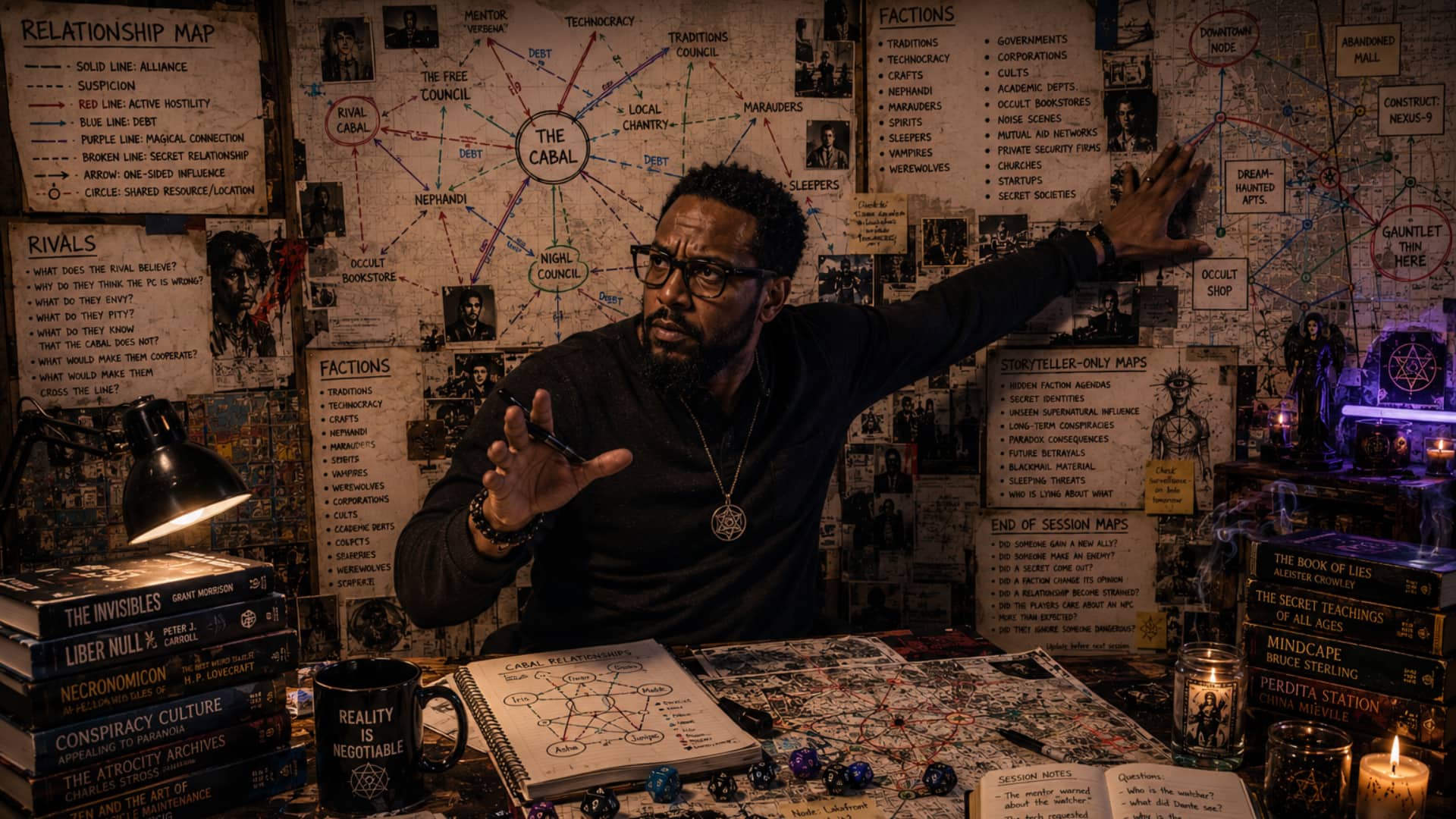
A relationship map is a visual tool that shows how characters, factions, locations, secrets, and conflicts connect.

It can be simple.

A circle for the cabal. A few names around it. Lines showing alliances, grudges, debts, secrets, and threats.

That’s enough.

The goal is not to create beautiful graphic design. The goal is to make the invisible structure of the chronicle visible. In Mage, that structure matters. Because the cabal is rarely dealing with one problem.

They are dealing with a web.

Why Relationship Maps Work So Well for Mage

Mage is not only about what characters can do. It is about what they believe. That means every relationship has ideological weight.

A mentor is not just a teacher. They are a worldview with a face.

A rival is not just an obstacle. They are proof that another kind of magic works.

A Technocrat is not just an antagonist. They may be someone who genuinely believes the cabal is dangerous.

A cult is not just a plot hook. It may be a failed attempt at Awakening.

A chantry is not just a clubhouse. It is politics, history, grudges, resources, secrets, and shared danger.

A relationship map helps you keep all of that alive.

Start With the Cabal

Put the player characters at the center.

Then ask:

  • Who trusts whom?
  • Who disagrees about magic?
  • Who has history?
  • Who shares a mentor?
  • Who owes someone an apology?
  • Who saw something together they cannot explain?
  • Who is hiding something?
  • Who would risk Paradox for another character?
  • Who would not?

The cabal does not need to be harmonious.

In Mage, disagreement can be fuel. But the Storyteller should understand the emotional architecture of the group.

Add Mentors

Every Mage mentor is a gift to the Storyteller. A mentor can provide guidance, resources, misinformation, pressure, guilt, affection, manipulation, or unfinished business.

For each mentor, write:

  • What did they teach?
  • What did they leave out?
  • What do they want from the student?
  • What do they fear the student will become?
  • What faction do they serve?
  • What secret are they hiding?
  • What mistake did they make years ago that is now returning?

A good mentor should be helpful. A great mentor should be complicated.

Add Rivals

Rivals are better than enemies. Enemies want the cabal gone. Rivals want to prove something. A rival can challenge a character’s beliefs, methods, status, ethics, or magical style.

Ask:

  • What does the rival believe?
  • Why do they think the player character is wrong?
  • What do they envy?
  • What do they pity?
  • What do they know that the cabal does not?
  • What would make them cooperate?
  • What would make them cross the line?

Mage thrives when conflict is philosophical as well as practical.

Add Factions

Now place the larger forces around the cabal.

  • Traditions
  • Technocracy
  • Crafts
  • Nephandi
  • Marauders
  • Spirits
  • Sleepers
  • Vampires
  • Werewolves
  • Governments
  • Corporations
  • Cults
  • Academic departments
  • Occult bookstores
  • Noise scenes
  • Mutual aid networks
  • Private security firms
  • Churches
  • Startups
  • Secret societies.

Each faction needs only three things:

  1. What they believe.
  2. What they want.
  3. What they will do if ignored.

That last one is important. The world should move even when the cabal does nothing.

Use Different Line Types

Make the map easy to read.

Use different kinds of lines:

  • Solid line: alliance
  • Dotted line: suspicion
  • Red line: active hostility
  • Blue line: debt
  • Purple line: magical connection
  • Broken line: secret relationship
  • Arrow: one-sided influence
  • Circle: shared resource or location

You do not need fancy software. Notebook paper works. Index cards work. A whiteboard works. A corkboard with string works if you want to fully embrace the conspiracy-wall aesthetic.

Map Secrets Separately

Some relationships should be visible to players. Others should remain Storyteller-only.

For example:

Visible:

  • The cabal knows their mentor dislikes the local Hermetic chantry.
  • The Technocracy is monitoring a downtown Node.
  • A local cult is recruiting Sleepers.

Hidden:

  • The mentor used to be part of that chantry.
  • The Technocracy is protecting the Node from something worse.
  • The cult’s leader is receiving dreams from a Marauder.

A good relationship map lets you track both the surface story and the hidden machinery underneath it.

Include Locations

In Mage, places matter.

Add important locations to your map:

  • Chantries
  • Constructs
  • Nodes
  • Libraries
  • Clubs
  • Churches
  • Hospitals
  • Universities
  • Corporate offices
  • Abandoned malls
  • Subway stations
  • Occult shops
  • Server farms
  • Dream-haunted apartments
  • Places where the Gauntlet feels thin

Then connect people to places.

  • Who controls the Node?
  • Who meets at the club?
  • Who died in the church basement?
  • Who owns the building through three shell companies?
  • Who refuses to go near the train station after midnight?

Locations become story engines when people want them, fear them, or lie about them.

Track Pressure, Not Just Information

A relationship map is not only a reference tool. It is a pressure machine.

Every few sessions, look at the map and ask:

  • Who has been ignored?
  • Who is getting nervous?
  • Who sees an opportunity?
  • Who feels betrayed?
  • Who wants repayment?
  • Who would make the next move?
  • Who has misunderstood the cabal’s actions?
  • Who benefits from escalating the conflict?

This keeps the chronicle alive. Instead of inventing random events, you let the map tell you what happens next.

Example: A Simple Mage Relationship Map

Start with:

The Cabal

Connected to:

Mentor A
Helpful, but hiding a past deal with the Technocracy.

Local Chantry Council
Wants the cabal useful, obedient, and out of trouble.

Technocracy Field Agent
Believes the cabal is reckless but not yet disposable.

Occult Bookstore Owner
Sleeper ally who knows more than they should.

Cult Leader
Recruiting people near a weak Node.

Marauder
Appears in dreams and may be warning the cabal.

Old Rival Cabal
Competing for status, resources, and moral superiority.

Now add lines:

  • Mentor A owes the Technocracy Field Agent.
  • The Cult Leader is unknowingly influenced by the Marauder.
  • The Bookstore Owner used to date someone on the Chantry Council.
  • The Rival Cabal wants the same Node.
  • The Technocracy Agent is protecting the Node from an entity in the Umbra.

That is already enough for months of play.

Player-Facing Maps

Consider letting players build part of the relationship map.

Ask them to add:

  • One ally
  • One rival
  • One person they owe
  • One person who owes them
  • One place that matters to them
  • One unresolved relationship
  • One secret connection

This gives players ownership of the chronicle. It also gives the Storyteller ready-made hooks.

When a player creates an NPC, they are telling you, “This person matters to me.”

Believe them. Use that.

Storyteller-Only Maps

Your private map can include deeper layers:

  • Hidden faction agendas
  • Secret identities
  • Unseen supernatural influence
  • Long-term conspiracies
  • Paradox consequences
  • Future betrayals
  • Blackmail material
  • Sleeping threats
  • Who is lying about what

Do not overcomplicate it. A map should make the game easier to run, not harder. If the map becomes a burden, simplify it.

Update the Map After Each Session

After every session, spend five minutes updating the map.

Ask:

  • Did someone gain a new ally?
  • Did someone make an enemy?
  • Did a secret come out?
  • Did a faction change its opinion of the cabal?
  • Did a relationship become strained?
  • Did the players care about an NPC more than expected?
  • Did they ignore someone dangerous?

Mage chronicles become stronger when the world remembers.

Relationship Maps Make Consequences Visible

The most satisfying moments in Mage often come from consequences. Not punishment. Consequences.

  • The cabal saves a spirit and angers a chantry.
  • They expose a Technocratic operation and create a power vacuum.
  • They help a cult member Awaken and accidentally create a rival.
  • They humiliate an enemy who later returns with better information.
  • They protect a Node and become responsible for it.

A relationship map helps you track the ripples. The players do something. The web moves. Reality responds.

Recommended Mage: The Podcast Episodes and Resources

These episodes pair well with relationship-map planning:

The Map Is Not the Territory

A relationship map is not the chronicle. It is a tool. Use it until it helps. Change it when the players surprise you. Ignore it when the table finds something better.

Mage is a game about changing reality. Your notes should be allowed to change too. But when the cabal is surrounded by factions, mentors, rivals, chantries, constructs, cults, spirits, and people who know too much, a relationship map gives you one precious advantage:

You can see the web before it catches fire.

Contact us at magethepodcast@gmail.com with feedback and comments, and please help extend the reach of the show by sharing it with friends.

Follow Us

Listen on Apple Podcasts, Spotify, YouTube, or your favorite podcast app.

Join our Discord server.

PAX Unplugged Conversations, Part 2

PAX Unplugged Conversations, Part 2

This week we’re back on the PAX Unplugged floor with a second round-up of lively, occasionally dusty-but-still-gold interviews from 2024. Terry chats with some absolute heavy hitters and indie darlings of tabletop RPGs about gods with day jobs, Afrofuturist sci-fi, cozy cosmic horror, zines, libraries, and why games should be played—not locked behind glass. Pull up a chair and enjoy the noise, the passion, and the love of the hobby. We’ll see you behind a table at PAX this coming December.

Show Notes

Executive Producers

Oracles

Bad Company • Buck Gregory • Christopher Phillips • Derek Semsick • DrawnCap • DrunkDez • Jason Vines • Rebecca Pool • Sean Gallagher • Spartacus • The Krewe of Erebuss

Archmasters

Berto • Brad-O-the Blue • Dan Svensson • Glacial Indifference • Jeffois • Leroy Bryce • Morgan Aran • Wolf Larryson

Acolytes

Aleks • Alexia • Ambiversion • Anders S • Ben Bandelow • Blaise Hebert • Bruno Teixeira • Bryce Perry • Bubba, The Pale One • Chartan • Cig • Curtis Hendricks • Darren Hennessey • Daniel Cuppen • Daniel Scribner • Dan Svensson • David Röhe • Ean Robertson • EBG • Eric Schwenke • Gray -Trilug- H • Guy Stewart • Ia Bull • James B • Jason Kennedy • Jenna F • Jeremy Z • Jervis Johnson • Kathleen Hailperin • Kevin Fitzpatrick • Khris Kinner • Leslie Weatherstone • Lolz & stuff • Loren Jensen • Manel Canós • Matthew Proehl • Maurice Hopkins • Melissa Krause • Michael Parker • Nebero • Nikita Kleymenov • Patrick McNamara • RobH • Ryan • Ryan Kendy • Ryan Stray • Samuel Tobin • Sev Nessus • Shell Konch • Starfish • Stefan Carton • Tyler Bryan • Will Vincent • Ygard

Become a supporter of Mage: The Podcast.

Contact us at magethepodcast@gmail.com with feedback and comments, and please help extend the reach of the show by sharing it with friends.

Follow Us

Listen on Apple Podcasts, Spotify, YouTube, or your favorite podcast app.

Join our Discord server.

Crossover: Ananasi in Mage

Crossover: Ananasi in Mage

This episode scuttles into the World of Darkness to talk Ananasi, the shape-shifting were-spiders from Werewolf: The Apocalypse. Adam covers the Weaver, the Triat, creepy spider lore, and why these eight-legged schemers make surprisingly good allies for mages. From Umbra webs to spider rebellions, we look at why bringing were-spiders into Mage games can be strange, spooky, and downright fun. 🕷️

Show Notes

  • Ananasi – This book’s got all the know-how you need, whether you’re spinning up a full-blown spider crew, sneaking a few extra legs into an ongoing Werewolf chronicle, or showing vampires that they’re not the only ones who know their way around a good blood meal.
  • The Wyld – Creation, chaos, possibility, raw dynamism.
  • The Wyrm – Entropy, decay, corruption, destruction.
  • Digital Web – Much like the Internet itself, the Digital Web isn’t really anywhere you can point to on a map, but it still matters. Think of it as a crossroads without a crossroads sign, the kind of place Correspondence loves to hang its hat, even if there’s no dirt under your boots.
  • Autochthonia (Iteration X Realm) – The Realm of Binding by Hermetics, is a Shenti of Stasis controlled by the Technocracy, a gigantic manifestation of the Weaver.
  • Malfeas (Realm of the Wyrm) – The mad Shenti realm of the Wyrm located in the Deep Umbra.
  • The Science Incarna – Science subsumed by systems and industry.

Executive Producers

Oracles

Bad Company • Buck Gregory • Christopher Phillips • Derek Semsick • DrawnCap • DrunkDez • Jason Vines • Rebecca Pool • Sean Gallagher • Spartacus • The Krewe of Erebuss

Archmasters

Berto • Brad-O-the Blue • Dan Svensson • Glacial Indifference • Jeffois • Leroy Bryce • Morgan Aran • Wolf Larryson

Acolytes

Aleks • Alexia • Ambiversion • Anders S • Ben Bandelow • Blaise Hebert • Bruno Teixeira • Bryce Perry • Bubba, The Pale One • Chartan • Cig • Curtis Hendricks • Darren Hennessey • Daniel Cuppen • Daniel Scribner • Dan Svensson • David Röhe • Ean Robertson • EBG • Eric Schwenke • Gray -Trilug- H • Guy Stewart • Ia Bull • James B • Jason Kennedy • Jenna F • Jeremy Z • Jervis Johnson • Kathleen Hailperin • Kevin Fitzpatrick • Khris Kinner • Leslie Weatherstone • Lolz & stuff • Loren Jensen • Manel Canós • Matthew Proehl • Maurice Hopkins • Melissa Krause • Michael Parker • Nebero • Nikita Kleymenov • Patrick McNamara • RobH • Ryan • Ryan Kendy • Ryan Stray • Samuel Tobin • Sev Nessus • Shell Konch • Starfish • Stefan Carton • Tyler Bryan • Will Vincent • Ygard

Become a supporter of Mage: The Podcast.

Contact us at magethepodcast@gmail.com with feedback and comments, and please help extend the reach of the show by sharing it with friends.

Follow Us

Listen on Apple Podcasts, Spotify, YouTube, or your favorite podcast app.

Join our Discord server.

Character Creation Aids for Mage: The Ascension

Character Creation Aids for Mage: The Ascension

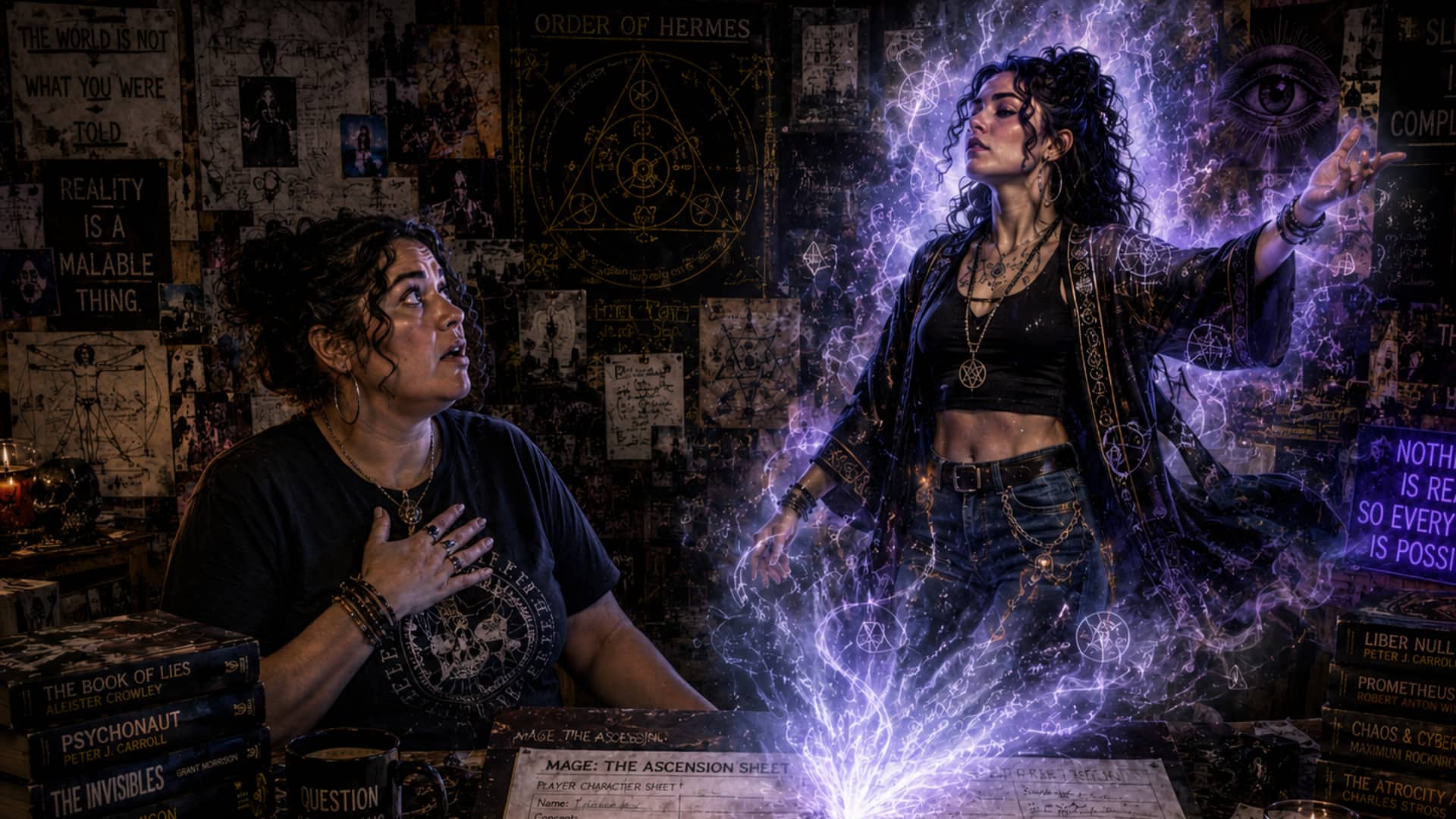
Mage characters are more than stats.

The best ones have beliefs, contradictions, obsessions, mentors, enemies, tools, rituals, and a theory of reality that can get them into trouble.

That is what makes character creation in Mage: The Ascension so rewarding. It is also what makes it difficult.

You are not just choosing dots on a sheet. You are building someone who looked at reality, saw the seams, and decided they could pull.

Start With Belief

Before you choose Spheres, ask:

What does this character believe is true?

Not what they know. Not what their Tradition teaches. What do they believe so deeply that magic can move through it?

A Mage character should have a worldview. Maybe they believe reality is code.

Maybe they believe the world is a living organism. Maybe they believe every human soul is a divine fragment. Maybe they believe language traps possibility. Maybe they believe the universe is a machine, a song, a wound, a joke, or a prison.

That belief is not flavor text.

It is the engine.

The Core Character Questions

Use these before touching the character sheet:

  • What did your character believe before Awakening?
  • What happened that made them realize reality was not fixed?
  • What did Awakening cost them?
  • Who taught them how magic works?
  • Who thinks they are dangerous?
  • What do they want badly enough to risk Paradox?
  • What part of their worldview is wrong?
  • What kind of magic feels natural to them?
  • What kind of magic disgusts or frightens them?
  • What would make them betray their own beliefs?

If you can answer those, the dots become easier.

Build a Contradiction

Great Mage characters are not perfectly coherent. They are human. Give them a contradiction.

Examples:

  • A Virtual Adept who hates being watched but cannot stop surveilling others
  • A Verbena healer who is terrified of death
  • A Hermetic who craves control but keeps falling in love with chaos
  • A Chorister who believes in divine unity but cannot forgive one person
  • A Technocrat who protects Sleepers but no longer believes the Union tells the truth
  • An Ecstatic who preaches freedom but keeps manipulating their friends
  • An Etherite who wants wonder but needs recognition

Contradictions create drama. They give the Storyteller something to challenge.

Choose an Obsession

Mage characters should want something. Not casually. Dangerously. An obsession gives the character momentum.

They might be obsessed with:

  • Finding their missing mentor
  • Proving their theory of reality
  • Destroying a Technocratic construct
  • Saving their neighborhood
  • Reaching the Umbra
  • Understanding their Avatar
  • Exposing a conspiracy
  • Awakening someone they love
  • Finding a lost grimoire
  • Undoing one terrible mistake

Obsession is useful because it answers the question:

Why does this character not just stay home?

Make the Avatar Personal

An Avatar should not feel like a generic power source. It should feel like pressure.

Ask:

  • How does the Avatar communicate?
  • Does it appear in dreams?
  • Does it speak?
  • Does it use symbols?
  • Does it feel loving, cruel, distant, hungry, playful, or alien?
  • What does it want?
  • What does it keep pushing the character toward?
  • What does the character fear it might really be?

The Avatar does not need to explain itself. In fact, it is often better when it does not.

Define Paradigm in Plain Language

Paradigm can feel intimidating, so simplify it.

Ask the player to finish this sentence:

Magic works because…

Examples:

  • Magic works because reality is made of information.
  • Magic works because the gods never left.
  • Magic works because the body remembers what the mind denies.
  • Magic works because machines are rituals with better branding.
  • Magic works because consciousness shapes probability.
  • Magic works because everything is connected through divine love.
  • Magic works because the world is a lie with weak security.

Once a player can say that, they have the beginning of a Paradigm.

Give Them Tools and Rituals

Mage magic should feel embodied. What does the character actually do?

Their Focus might include:

  • Prayer
  • Dance
  • Coding
  • Blood
  • Tarot
  • Street art
  • Equations
  • Drugs
  • Martial arts
  • Meditation
  • Hacking tools
  • Sacred geometry
  • Music
  • Tattoos
  • Cooking
  • Fashion
  • Corporate procedure
  • Medical equipment
  • Surveillance systems

The more specific the tools, the more memorable the magic. Not “I use Forces.”

Instead:

“I tune a busted police scanner to the frequency of a thunderstorm and speak the name of the first fire.”

That feels like Mage.

Create a Mentor

Every Mage needs someone who shaped them. A mentor can be loving, abusive, brilliant, absent, dead, manipulative, unreliable, or all of the above.

Ask:

  • Who taught the character?
  • What did they teach well?
  • What did they hide?
  • What do they still want?
  • What does the character owe them?
  • What warning did they give?
  • What did they get completely wrong?

A mentor gives the Storyteller instant story material.

Create an Enemy

An enemy does not have to be a villain. The best enemies often think they are right.

Ask:

  • Who wants this character stopped?
  • Who thinks they are wasting their gift?
  • Who envies them?
  • Who fears what they might become?
  • Who did they hurt during or after Awakening?
  • Who knows their secret?
  • Who wants to recruit them instead of destroy them?

An enemy gives the character tension before the chronicle even begins.

Connect Them to the Cabal

Mage is better when characters are tied together before play starts. Ask each player to connect their character to at least two others.

Possible connections:

  • We shared an Awakening experience.
  • We escaped the same enemy.
  • We studied under the same mentor.
  • I owe you my life.
  • I do not trust you, but I need you.
  • We loved the same person.
  • We saw the same impossible thing.
  • We disagree about everything except the mission.
  • You know what I did.
  • I know what you are becoming.

A cabal does not need harmony. It needs weight.

Let Spheres Follow Concept

New players often start with Spheres. Try reversing that.

Start with:

  • Belief
  • Obsession
  • Tools
  • Mentor
  • Enemy
  • Cabal role
  • Magical style

Then choose Spheres that support the character.

A street prophet who hears the city dreaming may naturally lean toward Correspondence, Mind, Spirit, or Entropy.

A biotech body-hacker might lean Life, Matter, Forces, or Data-flavored Correspondence.

A grief-haunted medium may need Spirit, Entropy, Time, or Mind.

The Spheres should feel like an expression of the character, not a shopping list.

Character Creation Worksheet

Use this as a quick aid.

Identity

Name:
Age:
Concept:
Tradition, Craft, Convention, or Orphan:
Role:

Belief

Magic works because:

Reality is:
Sleepers are wrong about:
My character is wrong about:

Awakening

What happened?
Who was there?
What changed afterward?
What did it cost?

Practice

Tools:
Rituals:
Symbols:
What coincidental magic looks like:
What vulgar magic looks like:

Relationships

Mentor:
Rival:
Enemy:
Sleeper connection:
Person I owe:
Person who owes me:
Cabal connection:

Trouble

Obsession:
Temptation:
Fear:
Secret:
Line I will not cross:
Line I might cross:

Common Character Creation Mistakes

Making a Power Set Instead of a Person

A Mage character is not “Forces 3, Prime 2.” That is what they can do. It is not who they are.

Making Paradigm Too Vague

“Energy manipulation” is less useful than “all matter is trapped music, and I know how to change the song.” Specificity creates better scenes.

Ignoring Sleepers

A mage with no Sleeper ties is easier to write but often less interesting.

Give them family, friends, jobs, debts, habits, and people who still think they are normal.

Avoiding Consequences

Mage characters should be dangerous to themselves.

Let them want things. Let them be wrong. Let their magic create problems.

That is where the story gets good.

Recommended Mage: The Podcast Episodes and Resources

These pair well with character creation:

The Goal Is Not a Perfect Character

The goal is a playable contradiction.

Someone with beliefs strong enough to bend reality and flaws strong enough to make that dangerous. Someone with tools, rituals, debts, enemies, mentors, and questions. Someone who does not just cast magic. Someone whose magic reveals who they are.

Because in Mage, character creation is not only about deciding what your mage can do. It is about deciding what kind of reality they are willing to fight for.

And what kind of reality might fight back.

Contact us at magethepodcast@gmail.com with feedback and comments, and please help extend the reach of the show by sharing it with friends.

Follow Us

Listen on Apple Podcasts, Spotify, YouTube, or your favorite podcast app.

Join our Discord server.

PAX Unplugged Conversations, Part 1

PAX Unplugged Conversations, Part 1

This episode travels back in time to PAX Unplugged 2024, where Terry Robinson captured interviews and loose, late-night conversations with creators and friends. This first installment (of two, or possibly three) features interviews with folks from AED Publishing, The Bodhana Group, and a rambling roundtable with Pooka and Mike from Darker Days Radio. We hope these final recordings from Terry are a fitting addition to his memorial and a little gift for the end of your year. Go forth, Mage strong!

Show Notes

  • PAX Unplugged – A tabletop gaming-focused convention specifically tailored to lovers of board games, RPGs, miniatures, cards, and more.
  • AED Publishing – An independent and privately owned publishing company focusing on the creation and distribution of character and story driven games founded by Stephen Koontz.
  • 5th Conspiracy (RPG) – Urban fantasy where belief shapes reality published by AED Publishing.
  • The Bodhana Group – Therapeutic tabletop gaming nonprofit.
  • Darker Days Radio – Premier horror rpg podcast

Executive Producers

Oracles

Bad Company • Buck Gregory • Christopher Phillips • Derek Semsick • DrawnCap • DrunkDez • Jason Vines • Rebecca Pool • Sean Gallagher • Spartacus • The Krewe of Erebuss

Archmasters

Berto • Brad-O-the Blue • Dan Svensson • Glacial Indifference • Jeffois • Leroy Bryce • Morgan Aran • Wolf Larryson

Acolytes

Aleks • Alexia • Ambiversion • Anders S • Ben Bandelow • Blaise Hebert • Bruno Teixeira • Bryce Perry • Bubba, The Pale One • Chartan • Cig • Curtis Hendricks • Darren Hennessey • Daniel Cuppen • Daniel Scribner • Dan Svensson • David Röhe • Ean Robertson • EBG • Eric Schwenke • Gray -Trilug- H • Guy Stewart • Ia Bull • James B • Jason Kennedy • Jenna F • Jeremy Z • Jervis Johnson • Kathleen Hailperin • Kevin Fitzpatrick • Khris Kinner • Leslie Weatherstone • Lolz & stuff • Loren Jensen • Manel Canós • Matthew Proehl • Maurice Hopkins • Melissa Krause • Michael Parker • Nebero • Nikita Kleymenov • Patrick McNamara • RobH • Ryan • Ryan Kendy • Ryan Stray • Samuel Tobin • Sev Nessus • Shell Konch • Starfish • Stefan Carton • Tyler Bryan • Will Vincent • Ygard

Become a supporter of Mage: The Podcast.

Contact us at magethepodcast@gmail.com with feedback and comments, and please help extend the reach of the show by sharing it with friends.

Follow Us

Listen on Apple Podcasts, Spotify, YouTube, or your favorite podcast app.

Join our Discord server.

Making Sense of the Digital Web

Making Sense of the Digital Web

Adam and James walk you through the Digital Web books. Then James discusses topics to consider when taking your players to the digital realm. Where is it in the Mage cosmos? How do you get there? How do you move around and work magick? What might you meet there? How does Augmented Reality really work? These topics and more are laid out to help you make the Digital Web a part of your games.

Show Notes

Executive Producers

Oracles

Bad Company • Buck Gregory • Christopher Phillips • Derek Semsick • DrawnCap • DrunkDez • Jason Vines • Rebecca Pool • Sean Gallagher • Spartacus • The Krewe of Erebuss

Archmasters

Berto • Brad-O-the Blue • Dan Svensson • Glacial Indifference • Jeffois • Leroy Bryce • Morgan Aran • Wolf Larryson

Acolytes

Aleks • Alexia • Ambiversion • Anders S • Ben Bandelow • Blaise Hebert • Bruno Teixeira • Bryce Perry • Bubba, The Pale One • Chartan • Cig • Curtis Hendricks • Darren Hennessey • Daniel Cuppen • Daniel Scribner • Dan Svensson • David Röhe • Ean Robertson • EBG • Eric Schwenke • Gray -Trilug- H • Guy Stewart • Ia Bull • James B • Jason Kennedy • Jenna F • Jeremy Z • Jervis Johnson • Kathleen Hailperin • Kevin Fitzpatrick • Khris Kinner • Leslie Weatherstone • Lolz & stuff • Loren Jensen • Manel Canós • Matthew Proehl • Maurice Hopkins • Melissa Krause • Michael Parker • Nebero • Nikita Kleymenov • Patrick McNamara • RobH • Ryan • Ryan Kendy • Ryan Stray • Samuel Tobin • Sev Nessus • Shell Konch • Starfish • Stefan Carton • Tyler Bryan • Will Vincent • Ygard

Become a supporter of Mage: The Podcast.

Contact us at magethepodcast@gmail.com with feedback and comments, and please help extend the reach of the show by sharing it with friends.

Follow Us

Listen on Apple Podcasts, Spotify, YouTube, or your favorite podcast app.

Join our Discord server.

Tomes of Magick: Weird Wonders & Revolutionary Magicks

Tomes of Magick: Weird Wonders & Revolutionary Magicks

What hath Empire wrought? Pooka and Jenna poke at that question today as they open up the supplement Weird Wonders and Revolutionary Magicks for Victorian Age Mage. The book features dozens of items, rotes, and story hooks, and while your mileage may vary with how much use you get out of them, there's no shortage of ideas to enrich any historical game.

Show Notes

Executive Producers

Oracles

Bad Company • Buck Gregory • Christopher Phillips • Derek Semsick • DrawnCap • DrunkDez • Jason Vines • Rebecca Pool • Sean Gallagher • Spartacus • The Krewe of Erebuss

Archmasters

Berto • Brad-O-the Blue • Dan Svensson • Glacial Indifference • Jeffois • Leroy Bryce • Morgan Aran • Wolf Larryson

Acolytes

Aleks • Alexia • Ambiversion • Anders S • Ben Bandelow • Blaise Hebert • Bruno Teixeira • Bryce Perry • Bubba, The Pale One • Chartan • Cig • Curtis Hendricks • Darren Hennessey • Daniel Cuppen • Daniel Scribner • Dan Svensson • David Röhe • Ean Robertson • EBG • Eric Schwenke • Gray -Trilug- H • Guy Stewart • Ia Bull • James B • Jason Kennedy • Jenna F • Jeremy Z • Jervis Johnson • Kathleen Hailperin • Kevin Fitzpatrick • Khris Kinner • Leslie Weatherstone • Lolz & stuff • Loren Jensen • Manel Canós • Matthew Proehl • Maurice Hopkins • Melissa Krause • Michael Parker • Nebero • Nikita Kleymenov • Patrick McNamara • RobH • Ryan • Ryan Kendy • Ryan Stray • Samuel Tobin • Sev Nessus • Shell Konch • Starfish • Stefan Carton • Tyler Bryan • Will Vincent • Ygard

Become a supporter of Mage: The Podcast.

Contact us at magethepodcast@gmail.com with feedback and comments, and please help extend the reach of the show by sharing it with friends.

Follow Us

Listen on Apple Podcasts, Spotify, YouTube, or your favorite podcast app.

Join our Discord server.

Paradigm Shift: Gardens of Ynn

Paradigm Shift: Gardens of Ynn

Ever wandered into a garden so beautiful you forgot the way out? 🌿 In this week’s Mage: The Podcast, Adam explores The Gardens of Inn — a mysterious, decaying fae realm from the OSR classic by Emmy Allen — and shows how it can bloom in your Mage: The Ascension game. Plus, a new “Paradigm Shift” series connects unexpected RPG books to the World of Darkness. 🎲

📄 Transcript of Paradigm Shift: Gardens of Ynn

Show Notes

Executive Producers

Oracles

Bad Company • Buck Gregory • Christopher Phillips • Derek Semsick • DrawnCap • DrunkDez • Jason Vines • Rebecca Pool • Sean Gallagher • Spartacus • The Krewe of Erebuss

Archmasters

Berto • Brad-O-the Blue • Dan Svensson • Glacial Indifference • Jeffois • Leroy Bryce • Morgan Aran • Wolf Larryson

Acolytes

Aleks • Alexia • Ambiversion • Anders S • Ben Bandelow • Blaise Hebert • Bruno Teixeira • Bryce Perry • Bubba, The Pale One • Chartan • Cig • Curtis Hendricks • Darren Hennessey • Daniel Cuppen • Daniel Scribner • Dan Svensson • David Röhe • Ean Robertson • EBG • Eric Schwenke • Gray -Trilug- H • Guy Stewart • Ia Bull • James B • Jason Kennedy • Jenna F • Jeremy Z • Jervis Johnson • Kathleen Hailperin • Kevin Fitzpatrick • Khris Kinner • Leslie Weatherstone • Lolz & stuff • Loren Jensen • Manel Canós • Matthew Proehl • Maurice Hopkins • Melissa Krause • Michael Parker • Nebero • Nikita Kleymenov • Patrick McNamara • RobH • Ryan • Ryan Kendy • Ryan Stray • Samuel Tobin • Sev Nessus • Shell Konch • Starfish • Stefan Carton • Tyler Bryan • Will Vincent • Ygard

Become a supporter of Mage: The Podcast.

Contact us at magethepodcast@gmail.com with feedback and comments, and please help extend the reach of the show by sharing it with friends.

Follow Us

Listen on Apple Podcasts, Spotify, YouTube, or your favorite podcast app.

Join our Discord server.